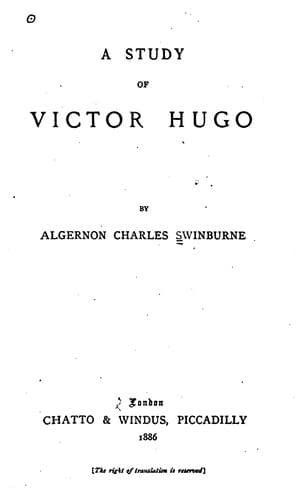
Hugo, Victor, 1802-1885 -- Criticism and interpretation
L'une dit:--Je fermais ton coffre-fort--Et l'autre
Dit:--J'ai servi de porte au toit qui fut le nôtre.--
L'autre dit:--Aux beaux jours,
La table où rit l'ivresse et que le vin encombre.
C'était moi.--L'autre dit:--J'étais le chevet sombre
Du lit de tes amours.
Among all the poems which follow, some exquisite in their mystic
tenderness as the elegiac stanzas on _Claire_ and the appealing address
to a friend unknown (_À celle qui est voilée_), others possessed with
the same faith and wrestling with the same questions as beset and
sustained the writer of the poem at which we have just rapidly and
reverently glanced, there are three at least which demand--at any rate
one passing word of homage. The solemn song of meditation "at the window
by night" seems to me to render in its first six lines the aspects and
sounds of sea and cloud and wind and trees and stars with an utterly
incomparable magic of interpretation.
Les étoiles, points d'or, percent les branches noires;
Le flot huileux et lourd décompose ses moires
Sur l'océan blêmi;
Les nuages ont l'air d'oiseaux prenant la fuite;
Par moments le vent parle, et dit des mots sans suite,
Comme un homme endormi.
No poet but one could have written the three stanzas, so full of
infinite sweetness and awe, inscribed "to the angels who see us."
--Passant, qu'es-tu? je te connais.
Mais, étant spectre, ombre et nuage,
Tu n'as plus de sexe ni d'âge.
--Je suis ta mère, et je venais!
--Et toi dont l'aile hésite et brille,
Dont l'œil est noyé de douceur,
Qu'es-tu, passant?--Je suis ta sœur.
--Et toi, qu'es-tu?--Je suis ta fille.
--Et toi, qu'es-tu, passant?--Je suis
Celle à qui tu disais: Je t'aime!
--Et toi?--Je suis ton âme même.--
Oh! cachez-moi, profondes nuits!
Nor could any other hand have achieved the pathetic perfection of the
verses in which just thirty years since, twelve years to a day after the
loss of his daughter, and fifteen years to a day before the return of
liberty which made possible the return of Victor Hugo to France, his
claims to the rest into which he now has entered, and his reasons for
desiring the attainment of that rest, found utterance unexcelled for
divine and deep simplicity by any utterance of man on earth.
_EN FRAPPANT À UNE PORTE_
J'ai perdu mon père et ma mère,
Mon premier-né, bien jeune, hélas!
Et pour moi la nature entière
Sonne le glas.
Je dormais entre mes deux frères;
Enfants, nous étions trois oiseaux;
Hélas! le sort change en deux bières
Leurs deux berceaux.
Je t'ai perdue, ô fille chère,
Toi qui remplis, ô mon orgueil,
Tout mon destin de la lumière
De ton cercueil!
J'ai su monter, j'ai su descendre.
J'ai vu l'aube et l'ombre en mes cieux.
J'ai connu la pourpre, et la cendre
Qui me va mieux.
J'ai connu les ardeurs profondes,
J'ai connu les sombres amours;
J'ai vu fuir les ailes, les ondes,
Les vents, les jours.
J'ai sur ma tête des orfraies;
J'ai sur tous mes travaux l'affront,
Au pied la poudre, au cœur des plaies,
L'épine au front.
Public-domain text, read in full here on John Shaqi.
Reviews
Reviews
No reviews yet
Be the first to share your thoughts on this work.
Join the Discussion
Join the discussion
Sign in to leave a comment or review.
Sign InorCreate an account