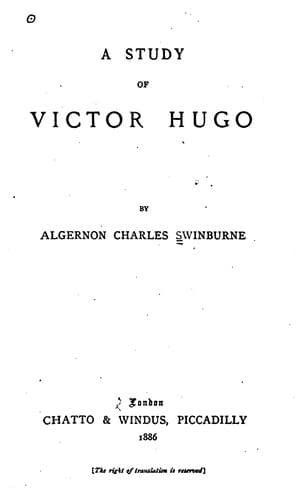
Hugo, Victor, 1802-1885 -- Criticism and interpretation
J'ai des pleurs à mon œil qui pense,
Des trous à ma robe en lambeau;
Je n'ai rien à la conscience;
Ouvre, tombeau.
Last comes the magnificent and rapturous hymn of universal redemption
from suffering as from sin, the prophetic vision of evil absorbed by
good, and the very worst of spirits transfigured into the likeness of
the very best, in which the daring and indomitable faith of the seer
finds dauntless and supreme expression in choral harmonies of unlimited
and illimitable hope. The epilogue which dedicates the book to the
daughter whose grave was now forbidden ground to her father--so long
wont to keep there the autumnal anniversary of his mourning--is the very
crown and flower of the immortal work which it inscribes, if we may say
so, rather to the presence than to the memory of the dead.
Not till the thirtieth year from the publication of these two volumes
was the inexhaustible labor of the spirit which inspired them to cease
for a moment--and then, among us at least, for ever. Three years
afterwards appeared the first series of the _Légende des Siècles_, to
be followed nineteen years later by the second, and by the final
complementary volume six years after that: so that between the inception
and the conclusion of the greatest single work accomplished in the
course of our century a quarter of that century had elapsed--with
stranger and more tragic evolution of events than any poet or any seer
could have foretold or foreseen as possible. Three years again from this
memorable date appeared the great epic and tragic poem of contemporary
life and of eternal humanity which gave us all the slowly ripened fruit
of the studies and emotions, the passions and the thoughts, the
aspiration and the experience, brought finally to their full and perfect
end in _Les Misérables._ As the key-note of _Notre-Dame de Paris_ was
doom--the human doom of suffering to be nobly or ignobly endured--so the
key-note of its author's next romance was redemption by acceptance of
suffering and discharge of duty in absolute and entire obedience to the
utmost exaction of conscience when it calls for atonement, of love when
it calls for sacrifice of all that makes life more endurable than death.
It is obvious that no account can here be given of a book which if it
required a sentence would require a volume to express the character of
its quality or the variety of its excellence--the one unique, the latter
infinite as the unique and infinite spirit whose intelligence and whose
goodness gave it life.
Public-domain text, read in full here on John Shaqi.
Reviews
Reviews
No reviews yet
Be the first to share your thoughts on this work.
Join the Discussion
Join the discussion
Sign in to leave a comment or review.
Sign InorCreate an account