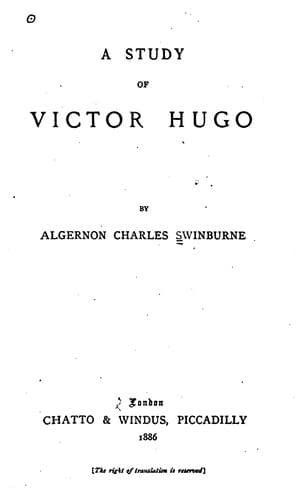
Hugo, Victor, 1802-1885 -- Criticism and interpretation
The most accurate and affectionate description that I ever saw or heard
given of a baby's incomparable smile, when graciously pleased to permit
with courtesy and accept with kindness the votive touch of a reverential
finger on its august little cheek, was given long since in the text
accompanying a rich and joyous design of childish revel by Richard
Doyle. A baby in arms is there contemplating the riotous delights of its
elders, fallen indeed from the sovereign state of infancy, but not yet
degenerate into the lower life of adults, with that bland and tacit air
of a large-minded and godlike tolerance which the devout observer will
not fail to have remarked in the aspect of babies when unvexed and
unincensed by any cross accident or any human shortcoming on the part of
their attendant ministers. Possibly a hand which could paint that
inexpressible smile might not fail also of the ability to render in mere
words some sense of the ineffable quality which rests upon every line
and syllable of this most divine poem. There are lines in it--but after
all this is but an indirect way of saying that it is a poem by Victor
Hugo--which may be taken as tests of the uttermost beauty, the extreme
perfection, the supreme capacity and charm, to which the language of men
can attain. It might seem as if the Fates could not allow two men
capable of such work to live together in one time of the world; and that
Shelley therefore had to die in his thirtieth year as soon as Hugo had
attained his twentieth.
Public-domain text, read in full here on John Shaqi.
Reviews
Reviews
No reviews yet
Be the first to share your thoughts on this work.
Join the Discussion
Join the discussion
Sign in to leave a comment or review.
Sign InorCreate an account