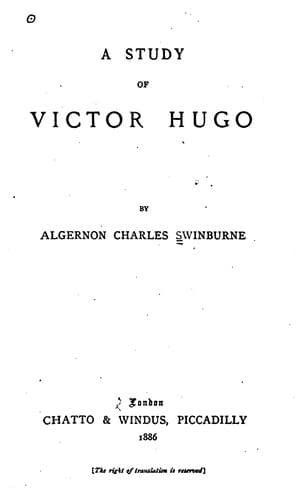
Hugo, Victor, 1802-1885 -- Criticism and interpretation
Let me be forgiven a seeming blasphemy; but since the time of
periphrasis is over the real truth of things must be said of them. Well,
then, the great peril of poetry is the risk it runs of becoming a
weariness: for it may be almost sublime, and yet perfectly wearisome:
but, on the contrary, with all its bewildering flight, its vast
circumference, and the rage of its genius grown drunk with things
immeasurable, the poetry of Victor Hugo is of itself _amusing_ into the
bargain--amusing as a fairy tale, as a many-colored festival, as a
lawless and charming comedy; for in them words play unexpected parts,
take on themselves a special and intense life, put on strange or
graceful faces, clash one against another either cymbals of gold or urns
of crystal, exchange flashes of living light and dawn.
And let no one suspect in my choice of an epithet any idea of
diminution; a garden-box on the window-sill may be thoroughly wearisome,
and an immense forest may be amusing, with its shades wherein the
nightingale sings, its giant trees with the blue sky showing through
them, its mossy shelters where the silver brooklet hums its tune through
the moistened greenery. Ay,--this is one of its qualities,--the poetry
of Hugo can be read, can be devoured as one devours a new novel, because
it is varied, surprising, full of the unforeseen, clear of commonplaces,
like nature itself; and of such a limpid clearness as to be within the
reach of every creature who can read, even when it soars to the highest
summits of philosophy and idealism. In fact, to be obscure, confused,
unintelligible, is not a rare quality, nor one difficult to acquire; and
the first fool you may fell in with can easily attain to it. In this
magnificent poem which has just appeared--as, for that matter, in all
his other poems--what Victor Hugo does is just to dispel and scatter to
the winds of heaven those lessons, those fogs, those rubbish-heaps,
those clouds of dark bewildered words with which the sham wise men of
all ages have overlaid the plain evidence of truth.
"The words of Mercury are harsh after the songs of Apollo"; and I, who
cannot pretend even to the gift of eloquence proper to the son of Maia,
will not presume to add a word of less valuable homage to the choicer
tribute of Banville. The three poems last mentioned were respectively
published in three successive years: and in the same year with
_Religions et Religion_ Victor Hugo published a fourth volume, _L'Âne_,
in which the questions of human learning and of human training were
handled with pathetic ardor and sympathetic irony. It would be
superfluous if not insolent to add that the might of hand, the magic of
utterance, the sovereign charm of sound, and the superb expression of
sense, are equal and incomparable in all.
Public-domain text, read in full here on John Shaqi.
Reviews
Reviews
No reviews yet
Be the first to share your thoughts on this work.
Join the Discussion
Join the discussion
Sign in to leave a comment or review.
Sign InorCreate an account