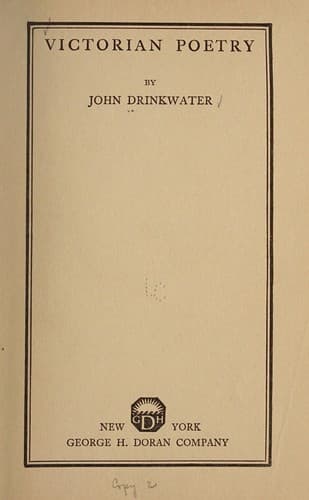
English poetry -- 19th century -- History and criticism; Great Britain -- History -- Victoria, 1837-1901
In nothing did the Victorian genius justify itself more fully than in
its love poetry. Love, a theme which, apart from the Augustan silence
which was broken only by such stray productions as James Hammond’s
_Love Elegies_, has been constant in English lyric poetry, had
never before been sung at one time with so many individual accents.
In the poetry of speculative thought and religion the Victorian
disintegration of mind may have led to a certain fluttered insecurity,
a lack of the superb moral poise which distinguishes the Greek and
the Miltonic epochs for example, when, no matter how individual the
poet, the rules as to what was and what was not the proper material
of poetry had some authority. It was not insignificant that whereas
Browning, we feel, could pick up the subject for a long philosophic
poem in a morning’s walk, Milton took twenty years to deliberate his
choice. But in love poetry the advantage, by the same conditions, was
with the Victorians. The law about the matter would seem to have a
strange streak of paradox in its nature. To take speculative religion
and love as contrasting themes by way of illustration, it would appear
that since speculative religion is a thing about which at no time can
there be any sort of standard or finality in the human mind, it is
on the whole better for the purposes of art that some such standard
arbitrarily fixed should be commonly accepted. On the other hand, since
love is a thing about which in its actual nature there is little or
no change from age to age as between one man and another, it profits
art when individual interpretations of love are as wide as possible
in their variety. The Greek drama, the high noon of Italian painting,
the seventeenth-century devotional school of English lyric, all these
gained enormously in impressiveness because in the creation of each of
them there was present to every artist a more or less fixed central
authority which he recognised as being greater than any he could set up
by his own unaided meditation. But in love the individual’s authority
is as great as any common authority can be, since love itself, as apart
from thought about love, is the same in its essential nature, whatever
measure of that nature may be given, to one man as to another, and
so there is gain when that thought about love, as distinguished from
love itself, is allowed the utmost freedom; and in this freedom the
Victorian age in poetry is more personal than any that had preceded it.
If we consider love poetry as a whole we shall find but an extremely
small part of it is concerned with the fundamental ecstasy of love
itself, with the adoration of the lover for the beloved in terms of
ordinary experience and not modified by special circumstance as it was,
for example, with Dante, and when it is so concerned it necessarily
changes hardly at all except in verbal idiom from age to age. Love
poetry, for the most part, is concerned not with love itself but with
Public-domain text, read in full here on John Shaqi.
Reviews
Reviews
No reviews yet
Be the first to share your thoughts on this work.
Elsewhere in the archive
Join the Discussion
Join the discussion
Sign in to leave a comment or review.
Sign InorCreate an account