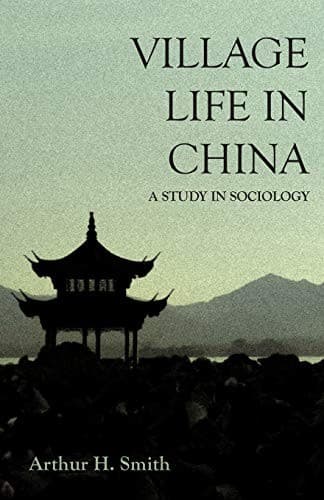
Village Life in China: A Study in SociologySmith, Arthur H.
General
Village Life in China: A Study in Sociology
Smith, Arthur H.
China -- Social life and customs; Villages
The reigning emperor of the Tang Dynasty sent for Chang Kung, to inquire
the secret of such wonderful harmony, and calling for a pen, he is said to
have written the character denoting "Forbearance" a great number of times.
According to tradition the picture of this patriarch was placed in every
dwelling as a stimulus to the imitation of his example, a purpose for
which it unfortunately proves quite inert.
That the dwellings of the Chinese are cold in winter, hot in summer, and
smoky all the year round is inevitable. Even in the coldest weather there
is no escape from the bitter cold, except as it may be got by curling upon
the _k'ang_. For this reason Chinese women often speak of the _k'ang_ as
like an "own mother." A room in which there is none is considered almost
uninhabitable. But from an Occidental point of view they are models of
discomfort. The heat is but slowly diffused, and during a long night one
may be alternately drenched with perspiration, and then chilled to the
bone as the heat diminishes. The adobe bricks of which the _k'ang_ is
composed crumble if an uneven pressure is made upon them, so that one
often finds the _k'angs_ in an inn full of pitfalls. They are always the
lodging places of a multitude of tiny monsters to which the Chinese are
too much accustomed to complain. Even when the adobe bricks are broken up
in the spring to be pulverized as manure--on account of the creosote--the
animal life lodged in the walls is apparently sufficient to restock the
universe.
It is not surprising that the title-deeds to land are in course of years
destroyed or lost, for there is in a Chinese house no proper place in
which they may be kept. The only closets are made by leaving out a few
bricks from the wall. A small board, resting on two pegs often forms the
only book-shelf to be found in the apartments even of men of letters.
Doors are locked by passing the link of a chain over a staple in the
door-frame above; but Chinese padlocks can generally be picked with a
wire, a chop-stick, or even with a dry weed, and afford no real
protection. Thieves are always provided with an assortment of keys, and
often get in by lifting the doors off the pins which serve as hinges.
Nothing is easier than to dig through adobe walls. In some of the rich
villages of Shan-hsi house-walls are built quite six feet thick to
discourage such penetration.
Public-domain text, read in full here on John Shaqi.
Reviews
Reviews
No reviews yet
Be the first to share your thoughts on this work.
Join the Discussion
Join the discussion
Sign in to leave a comment or review.
Sign InorCreate an account