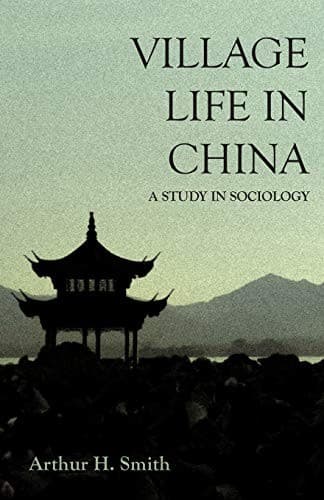
Village Life in China: A Study in SociologySmith, Arthur H.
General
Village Life in China: A Study in Sociology
Smith, Arthur H.
China -- Social life and customs; Villages
Upon another occasion, while the _Ko Lao_ himself was alive, a complaint
was made to the District Magistrate that a son of the _Ko Lao_ had a
maidservant, who was virtually imprisoned in the family mansion. She was
originally hired having been betrothed, but although it was time for her
to be married, her employer refused to let her go. The Magistrate sent for
the son of the _Ko Lao_, made known the charge, and desired the release of
the person detained. He even went to the length of beating the attendant
of the Lu family, who had accompanied his master, the latter being himself
too lofty a subject for punishment. The son went to his home in a towering
rage, and wrote a letter to his father in Peking, detailing the
circumstances. Soon after this, the Magistrate received the news of his
promotion from the grade of Sub-prefect to that of Prefect, in the
province of Ssŭ-ch'uan.
The journey to a new post is often a most serious matter for an official,
and where, as in this case, he has the entire empire to cross, the trouble
and expense are very great. He had no sooner reached this distant post,
than he received a notification that he was promoted to another in the
province of Yün-nan, again involving an expensive and tedious journey.
When he had at length taken up the duties of this office it was only to
be informed that he was promoted afresh to the high rank of Tao-t'ai in a
region beyond the Great Wall. He now began to perceive the significance of
this strange series of events, and wholly unable either to bear the ills
which he already had, or to support the prospect of perhaps greater ones
yet to come, he "swallowed gold," and thus escaped further promotion and
ruin!
XXI
VILLAGE HEADMEN
Many of the phenomena of village life which we shall have occasion to
notice, are instances of the Chinese talent for coöperation.
Perhaps no more important exemplification of this principle is to be found
in Chinese society than that embodied in the local self-government of the
small communities of which the greater part of the empire is composed. The
management of the village is in the hands of the people themselves. At
first this condition of affairs is liable to be mistaken for a pure
democracy, but very slight inquiry is sufficient to make it evident that
while all matters of local concern are theoretically managed by the
people, in practice the burden falls not upon the people as a whole, but
upon the shoulders of a few persons, who in different places are called by
different titles and whose functions differ as much as their designations.
Public-domain text, read in full here on John Shaqi.
Reviews
Reviews
No reviews yet
Be the first to share your thoughts on this work.
Elsewhere in the archive
Join the Discussion
Join the discussion
Sign in to leave a comment or review.
Sign InorCreate an account