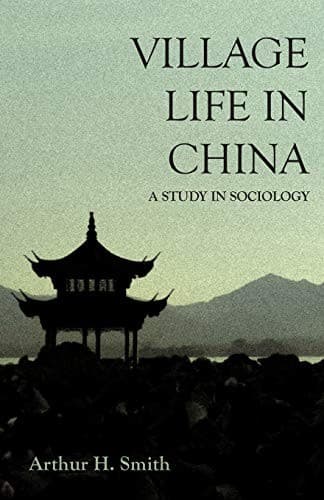
Village Life in China: A Study in SociologySmith, Arthur H.
General
Village Life in China: A Study in Sociology
Smith, Arthur H.
China -- Social life and customs; Villages
The apparent dead-level uniformity of China is found upon investigation to
be subject to surprising variations, not only in parts of the empire
remote from one another, but in those which are separated by but a short
distance. On this account it is difficult to generalize in regard to the
government of villages in general, but easy to describe that of some
villages, with the explanation that elsewhere the same results may be
attained by means slightly different, or by the same means under different
names.
Every Chinese village is a little principality by itself, although it is
not uncommon for two or more which are contiguous and perhaps otherwise
linked together, to manage their affairs in unison, and perhaps by the
same set of persons. These headmen are sometimes styled _village elders_
(_hsiang chang_, or _hsiang lao_), and sometimes they are termed merely
managers (_shou shih jên_). The theory in regard to these persons is that
they are chosen, or rather nominated, by their fellow-townsmen, and
confirmed in their position by the District Magistrate. In some regions
this is actually done, and for the good conduct of the headmen in their
office the leading land-owners are required to become a security.
The designation "village elders" might be understood to denote that the
persons who bear it are the oldest men in the village, but this is not
necessarily the case. Neither are they necessarily the wealthiest men,
although it is probable that every family of property will be in some way
represented among them. They are not necessarily men of literary
attainments, although this may be the case with a few.
In those regions where the method of selection is most loose, the number
of headmen has no necessary relation to the size of the village; the
position is not hereditary, neither is there any fixed time of service. A
man may act in this capacity at one time, and refuse or neglect to do so
at another time. Where this plan prevails, the headmen are not formally
chosen, nor formally deposed. They drop into their places--or perhaps
climb into them--by a kind of natural selection. The qualities which fit a
villager to act as headman are the same which contribute to success in any
line of business. He must be a practical person who has some native
ability, acquainted with the ways of the world, as well as able and
willing to devote upon occasion an indefinite amount of time and attention
to the affairs which may be put in his charge.
The duties and functions of the headmen are numerous. They may be
classified as those which have relation to the government of the District,
those which relate to the village as such, and those which concern private
individuals, and are brought to the notice of the headmen as being the
persons best able to manage them.
Public-domain text, read in full here on John Shaqi.
Reviews
Reviews
No reviews yet
Be the first to share your thoughts on this work.
Elsewhere in the archive
Join the Discussion
Join the discussion
Sign in to leave a comment or review.
Sign InorCreate an account