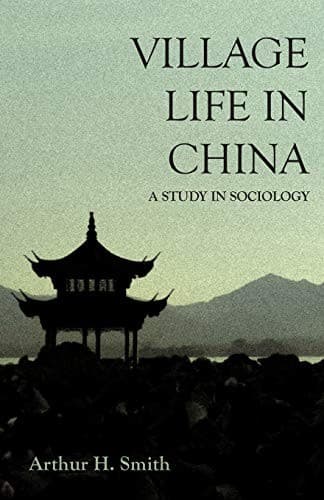
Village Life in China: A Study in SociologySmith, Arthur H.
General
Village Life in China: A Study in Sociology
Smith, Arthur H.
China -- Social life and customs; Villages
school near the district city, made it a constant practice for many years,
to attend examinations of this sort. He was examined about a hundred
times, and on four occasions received a prize, once a sum in money
equivalent to about seventy-five cents, and three other times a sum equal
to about half-a-dollar!
It is a constant wonder to Occidentals, by what motives the Chinese are
impelled, in their irrepressible thirst for literary degrees, even under
all the drawbacks and disadvantages, some of which have been described.
These motives, like all others in human experience are mixed, but at the
base of them all, is a desire for fame and for power. In China the power
is in the hands of the learned and of the rich. Wealth is harder to
acquire than learning, and incomparably more difficult to keep. The
immemorial traditions of the empire are all in favour of the man who is
willing to submit to the toils that he may win the rewards of the scholar.
Every village as already explained, has its headmen. Among them the
literary graduate, provided he is also a practical man, will inevitably
take the lead. He will often come into relations with the District
Magistrate, which makes him a marked man among his fellows. He will be
constantly called upon to assist in the settlement of disputes, and every
such occasion will afford opportunities for the privilege, so dear to the
Chinese, of enjoying a feast at the expense of his neighbours, besides
putting them under an obligation to him for his trouble. At the weddings
and funerals within the large circle of his acquaintance he will be a
frequent guest, and always in the place of honour due to his literary
degree. This is especially the case in funeral ceremonies of those who are
buried with the most elaborate ritual. On these occasions the ancestral
tablet of the deceased is to be written, and as an important part of the
exercises a red dot over one character signifying King is to be placed,
thus changing it into the symbol denoting Lord. It is not uncommon to have
the performances connected with such funerals extended over several days,
each furnishing three excellent feasts, as well as abundant supplies of
opium for those who wish to smoke. In a country like China the
participation in revels such as these approach more nearly to paradisaic
bliss than anything of which the Chinese mind can conceive. Every scholar
is desirous of getting into such relations with his environment that
honours of this sort come to him as a matter of course. If he happens to
be very poor, they furnish a not unimportant part of his support, as well
as of his happiness.
Public-domain text, read in full here on John Shaqi.
Reviews
Reviews
No reviews yet
Be the first to share your thoughts on this work.
Elsewhere in the archive
Join the Discussion
Join the discussion
Sign in to leave a comment or review.
Sign InorCreate an account