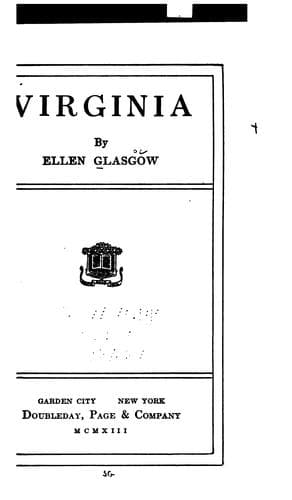
Marriage -- Fiction; Virginia -- Fiction; Wives -- Fiction; Women -- Fiction
had ever been in the past.
The front door opened and shut; there was a step on the soft grass under
the honeysuckle-trellis, and her father came towards her, with his long
black coat flapping about him. He always wore clothes several sizes too
large for him under the impression that it was a point of economy and
that they would last longer if there was no "strain" put upon them. He
was a small, wiry man, with an amazing amount of strength for his build,
and a keen, humorous face, ornamented by a pointed chin beard which he
called his "goatee." His eyes were light grey with a twinkle which
rarely left them except at the altar, and the skin of his cheeks had
never lost the drawn and parchment-like look acquired during the last
years of the war. One of the many martial Christians of the Confederacy,
he had laid aside his surplice at the first call for troops to defend
the borders, and had resumed it immediately after the surrender at
Appomattox. It was still an open question in Dinwiddie whether Gabriel
Pendleton, who was admitted to have been born a saint, had achieved
greater distinction as a fighter or a clergyman; though he himself had
accepted the opposite vocations with equal humility. Only in the dead of
sweltering summer nights did he sometimes arouse his wife with a groan
and the halting words, "Lucy, I can't sleep for thinking of those men I
killed in the war." But with the earliest breeze of dawn, his remorse
usually left him, and he would rise and go about his parochial duties
with the serene and child-like trust in Providence that had once carried
him into battle. A militant idealism had ennobled his fighting as it now
exalted his preaching. He had never in his life seen things as they are
because he had seen them always by the white flame of a soul on fire
with righteousness. To reach his mind, impressions of persons or objects
had first to pass through a refining atmosphere in which all baser
substances were eliminated, and no fact had ever penetrated this medium
except in the flattering disguise of a sentiment. Having married at
twenty an idealist only less ignorant of the world than himself, he had,
inspired by her example, immediately directed his energies towards the
whitewashing of the actuality. Both cherished the naïve conviction that
to acknowledge an evil is in a manner to countenance its existence, and
both clung fervently to the belief that a pretty sham has a more
intimate relation to morality than has an ugly truth. Yet so unconscious
were they of weaving this elaborate tissue of illusion around the world
they inhabited that they called the mental process by which they
distorted the reality, "taking a true view of life." To "take a true
view" was to believe what was pleasant against what was painful in spite
of evidence: to grant honesty to all men (with the possible exception of
the Yankee army and a few local scalawags known as Readjusters); to deny
Public-domain text, read in full here on John Shaqi.
Reviews
Reviews
No reviews yet
Be the first to share your thoughts on this work.
Join the Discussion
Join the discussion
Sign in to leave a comment or review.
Sign InorCreate an account