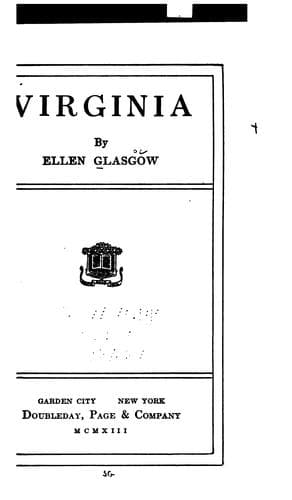
Marriage -- Fiction; Virginia -- Fiction; Wives -- Fiction; Women -- Fiction
virtue to no woman, not even to the New England Abolitionist; to regard
the period before the war in Virginia as attained perfection, and the
present as falling short of that perfection only inasmuch as it had
occurred since the surrender. As life in a small place, among a simple
and guileless class of gentlefolk, all passionately cherishing the same
opinions, had never shaken these illusions, it was but natural that they
should have done their best to hand them down as sacred heirlooms to
their only child. Even Gabriel's four years of hard fighting and scant
rations were enkindled by so much of the disinterested idealism that
had sent his State into the Confederacy, that he had emerged from them
with an impoverished body, but an enriched spirit. Combined with his
inherent inability to face the facts of life, there was an almost
superhuman capacity for cheerful recovery from the shocks of adversity.
Since he had married by accident the one woman who was made for him, he
had managed to preserve untarnished his innocent assumption that
marriages were arranged in Heaven--for the domestic infelicities of many
of his parishioners were powerless to affect a belief that was founded
upon a solitary personal experience. Unhappy marriages, like all other
misfortunes of society, he was inclined to regard as entirely modern and
due mainly to the decay of antebellum institutions. "I don't remember
that I ever heard of a discontented servant or an unhappy marriage in my
boyhood," he would say when he was forced against his will to consider
either of these disturbing problems. Not progress, but a return to the
"ideals of our ancestors," was his sole hope for the future; and in
Virginia's childhood she had grown to regard this phrase as second in
reverence only to that other familiar invocation: "If it be the will of
God."
As he stood now in the square of lamplight that streamed from the
drawing-room window, she looked into his thin, humorous face, so
spiritualized by poverty and self-sacrifice that it had become merely
the veil for his soul, and the thought came to her that she had never
really seen him as he was until to-day.
Public-domain text, read in full here on John Shaqi.
Reviews
Reviews
No reviews yet
Be the first to share your thoughts on this work.
Join the Discussion
Join the discussion
Sign in to leave a comment or review.
Sign InorCreate an account