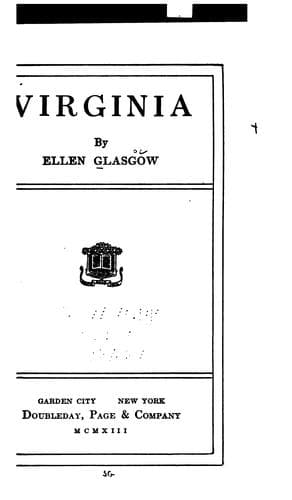
Marriage -- Fiction; Virginia -- Fiction; Wives -- Fiction; Women -- Fiction
This was so heretical a point of view that she tried earnestly to
comprehend it; but all the time her heart was busy telling her how
different he was from every other man--how much more interesting! how
immeasurably superior! Her attention, in spite of her efforts at serious
thought, would not wander from the charm of his voice, from the peculiar
whimsical trick of his smile, which lifted his mouth at one corner and
made odd little wrinkles come and go about his eyes. His manner was full
of sudden nervous gestures which surprised and enchanted her. All other
men were not merely as clay beside him--they were as straw! Seeing that
he was waiting for a response, she made a violent endeavour to think of
one, and uttered almost inaudibly: "But don't they like it?"
"Ah, that's just it," he answered as seriously as if she hadn't known
that her speech bordered on imbecility. "Do they really like it? or have
they been throwing dust in our eyes through the centuries?" And he gazed
at her as eagerly as if he were hanging upon her answer. Oh, if she
could only say something clever! If she could only say the sort of thing
that would shock Miss Priscilla! But nothing came of her wish, and she
was reduced at last to the pathetic rejoinder, "I don't know. I'm afraid
I've never thought about it."
For a moment he stared at her as though he were enraptured by her reply.
With such eyes and such hair, she might have been as simple as she
appeared and he would never have known it. "Of course you haven't, or
you wouldn't be you!" he responded; and by the time she came to her
senses, she was following her mother and the negro urchin out of the
market. Though she was in reality walking over cinders, she felt that
her feet were treading on golden air.
CHAPTER IV
THE TREADWELLS
Above the Dinwiddie of Virginia's girlhood, rising sharply out of the
smoothly blended level of personalities, there towered, as far back as
she could remember, the grim and yet strangely living figure of Cyrus
Treadwell. From the intimate social life of the town he had remained
immovably detached; but from the beginning it had been impossible for
that life to ignore him. Among a people knit by a common pulse, yet
separated by a multitude of individual differences, he stood aloof and
indispensable, like one of the gaunt iron bridges of his great railroad.
He was at once the destroyer and the builder--the inexorable foe of the
old feudal order and the beneficent source of the new industrialism.
Though half of Dinwiddie hated him, the other half (hating him, perhaps
none the less) ate its bread from his hands. The town, which had lived,
fought, lost, and suffered not as a group of individuals, but as a
psychological unit, had surrendered at last, less to the idea of
readjustment than to the indomitable purpose of a single mind.
Public-domain text, read in full here on John Shaqi.
Reviews
Reviews
No reviews yet
Be the first to share your thoughts on this work.
Join the Discussion
Join the discussion
Sign in to leave a comment or review.
Sign InorCreate an account