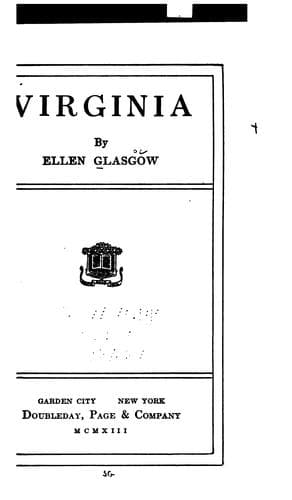
Marriage -- Fiction; Virginia -- Fiction; Wives -- Fiction; Women -- Fiction
And yet nobody in Dinwiddie, not even Miss Willy Whitlow, who sewed out
by the day, and knew the intimate structure of every skeleton in every
closet of the town--nobody could tell the precise instant at which Cyrus
had ceased to be an ordinary man and become a great one. A phrase,
which had started as usual, "The Mr. Treadwell, you know, who married
poor Belinda Bolingbroke--" swerved suddenly to "Cyrus Treadwell told me
that, and you must admit that _he_ knows what he is talking about"--and
a reputation was made! His marriage to "poor Belinda," which had at
first appeared to be the most conspicuous fact in his career, dwindled
to insignificance beside the rebuilding of the tobacco industry and his
immediate elevation to the vacant presidency of one of the Machlin
railroads.
It was true that in the meantime he had fought irreproachably, but
without renown, through a number of battles; and returning to a
vanquished and ruined city, had found himself still young enough to go
to school again in matters of finance. Whether he had learned from
Antrum, the despised carpet-bagger for Machlin & Company, or had taken
his instructions at first hand from the great Machlin himself, was in
the eighties an open question in Dinwiddie. The choice was probably
given him to learn or starve; and aided by the keen understanding and
the acute sense of property he had inherited from his Scotch-Irish
parentage, he had doubtless decided that to learn was, after all, the
easier way. Saving he had always been, and yet with such strange and
sudden starts of generosity that he had been known to seek out distant
obscure maiden relatives and redeem the mortgaged roof over their heads.
His strongest instinct, which was merely an attenuated shoot from his
supreme feeling for possessions, was that of race, though he had
estranged both his son and his daughter by his stubborn conviction that
he was not doing his duty by them except when he was making their lives
a burden. For, as with most men who have suffered in their youth under
oppression, his ambition was not so much to relieve the oppressed as to
become in his turn the oppressor. Owing, perhaps, to his fine
Scotch-Irish blood, which ran a little muddy in his veins, he had never
lost a certain primitive feeling of superstition, like the decaying root
of a religious instinct; and he was as strict in his attendance upon
church as he was loose in applying the principles of Christianity to his
daily life. Sunday was vaguely associated in his mind with such popular
fetiches as a frock coat and a roast of beef; and if the roast had been
absent from dinner, he would have felt precisely the same indefinite
disquietude that troubled him when the sermon was left out of the
service. So completely did his outward life shape itself around the
inner structure of his thought, that, except for the two days of the
week which he spent with unfailing regularity in Wall Street, he might
have been said to live only in his office.
Public-domain text, read in full here on John Shaqi.
Reviews
Reviews
No reviews yet
Be the first to share your thoughts on this work.
Join the Discussion
Join the discussion
Sign in to leave a comment or review.
Sign InorCreate an account