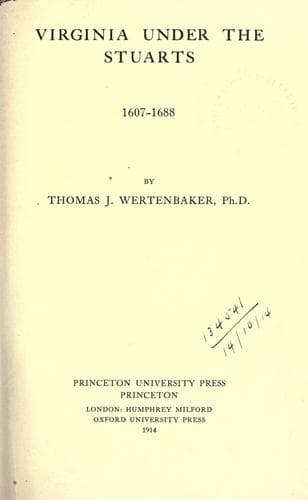
Virginia under the Stuarts 1607-1688Wertenbaker, Thomas Jefferson
History
Virginia under the Stuarts 1607-1688
Wertenbaker, Thomas Jefferson
Virginia -- History -- Colonial period, ca. 1600-1775
This new material adds new weight to the conclusions reached in this
book--that the causes of Bacon's Rebellion were deep-seated, that it
grew out of the discontent caused by the Navigation Acts, the heavy
taxes, the corrupting of the Assembly by Berkeley, and the misuse of the
courts. It in no way shakes the conviction expressed by Thomas Mathews,
who himself was involved in the rebellion, that the Indian war was the
excuse for it rather than the cause.
Yet certain recent historians have contended that this violent uprising
was not a protest against injustice and misgovernment. One has gone so
far as to call it merely a quarrel between a rash young man and an old
fool. We could with equal justice call the American Revolution just a
quarrel between George Washington and George III. Mathews tells us that
it was the general opinion in Virginia at the time that it was not Bacon
who was chiefly responsible for the uprising, but Thomas Lawrence. Bacon
"was too young, too much a stranger there, and of a disposition too
precipitate to manage things to that length they were carried," he
pointed out, "had not thoughtful Mr. Lawrence been at the bottom."
But neither Lawrence's hatred of Berkeley, nor Bacon's rashness, nor
Berkeley's folly, nor the Indian war suffice to explain the rebellion.
When the news of the uprising reached Charles II, he thought it past
belief that "so considerable body of men, without the least grievance
or oppression, should rise up in arms and overthrow the government." He
was quite right. Had there been no grievances and oppression there would
have been no uprising.
That Bacon's Rebellion is explained in part by poverty and suffering is
clear. Philip Ludwell said that the rebel army was composed of men
"whose condition ... was such that a change could not make worse." The
men who fought so valiantly against the Indians and Berkeley's forces,
braved the King's anger, faced death on the gallows were called in
contempt "the bases of the people," "the rabble," the "scum of the
people," "idle and poor people," "rag, tag, and bobtail." The Council
reported that there were "hardly two amongst them" who owned estates, or
were persons of reputation. Berkeley complained that his was a miserable
task to govern a people "where six parts of seven at least are poor,
indebted, discontented, and armed."
So when Bacon sent out his agents to every part of Virginia to denounce
the governor for not permitting an election for a new Assembly, accusing
him of misgovernment, and complaining of the heavy and unequal taxes,
they "infested the whole country." Berkeley stated that the contaigion
spread "like a train of powder." Never before was there "so great a
madness as this base people are generally seized with." When, in panic,
he dissolved the Long Assembly and called for a new election, all except
eight of those chosen were pro-Bacon men.
Public-domain text, read in full here on John Shaqi.
Reviews
Reviews
No reviews yet
Be the first to share your thoughts on this work.
Join the Discussion
Join the discussion
Sign in to leave a comment or review.
Sign InorCreate an account