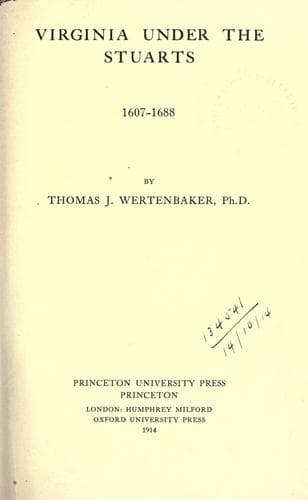
Virginia under the Stuarts 1607-1688Wertenbaker, Thomas Jefferson
History
Virginia under the Stuarts 1607-1688
Wertenbaker, Thomas Jefferson
Virginia -- History -- Colonial period, ca. 1600-1775
One cannot but ask why. Surely the voters would not have sided with this
young man who had been in Virginia but a few months had he not taken the
lead in protesting against the many wrongs to which they had been
subjected. And had those who rushed to arms, risking their property, if
not their necks, done so merely because of a quarrel between Bacon and
Berkeley, they would have been more than base, they would have been
fools.
What these wrongs were Bacon and his followers tell us in what they
called the Declaration of the People. Berkeley and his favorites they
denounced "for having upon specious pretences of public works raised
great unjust taxes upon the commonalty for the advancement of private
favorites and other sinister ends...; for having abused and rendered
contemptible the magistrates of justice, by advancing to places of
judicature scandalous and ignorant favorites...."
In a burning manifesto, denouncing the injustice and corruption of the
ruling group, Bacon said: "We appeal to the country itself what and of
what nature their oppressions have been, and by what cabal and mystery
the design of many of those whom we call great men have been transacted
and carried on.... See what sponges have sucked up the public wealth and
whether it hath not been privately contrived away by unworthy favorites,
by vile juggling parasites, whose tottering fortunes have been repaired
and supported by the charge." The constant breach of laws, unjust
prosecutions, excuses, and evasions, proved that the men in power were
conducting public affairs "as if it were but to play a booty, game, or
divide a spoil."
In view of these statements recent attempts to prove that Bacon was no
true patriot and not interested in righting the people's wrongs seem
strange indeed. It is hardly credible that he was merely pretending when
he wrote these fiery words, that he posed as the champion of the people
to further his personal ambitions, that he trumped up charges against
Berkeley because of the disagreement over the Indian war.
But, it has been said, Bacon showed no interest in the passage of the
reform laws enacted by the Assembly of June 1676, refused to have them
read before his army, and complained that the Burgesses had not lived up
to his expectations. Had he been really interested in reform, would he
not have gloried in these laws and have praised the Assembly for passing
them?
Any such conclusion falls flat when we consider the conditions under
which this session was held. The Burgesses had hardly taken their seats
when Bacon, who had been elected as one of the members to represent
Henrico County, was captured. Though Berkeley pardoned him and restored
him to his seat in the Council, he was a virtual prisoner during the
first few days of the session. So he looked on with growing resentment
as the governor overawed the Burgesses and reform measures were set
aside.
Public-domain text, read in full here on John Shaqi.
Reviews
Reviews
No reviews yet
Be the first to share your thoughts on this work.
Join the Discussion
Join the discussion
Sign in to leave a comment or review.
Sign InorCreate an account