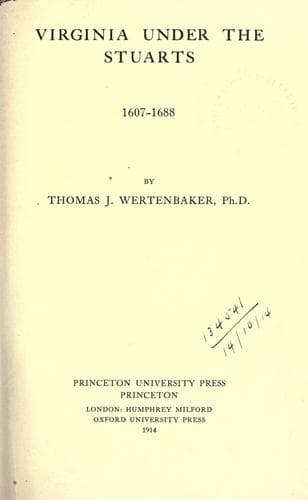
Virginia under the Stuarts 1607-1688Wertenbaker, Thomas Jefferson
History
Virginia under the Stuarts 1607-1688
Wertenbaker, Thomas Jefferson
Virginia -- History -- Colonial period, ca. 1600-1775
But Culpeper's many defects were not wholly unfortunate for the colony,
for they rendered him unfit to carry out the designs of the King. His
frequent absences from his government made it impossible for him to
become thoroughly acquainted with conditions in the colony, or to bind
the wealthy to him by a judicious use of the patronage. He was too weak,
too careless to pursue a long continued attack upon the established
privileges of the people.
It boded ill, therefore, for Virginia, when he was removed, and a
commission granted to Lord Howard. The new Governor was well fitted for
the task of oppression and coercion. Unscrupulous,
deceitful, overbearing, resentful, persistent, he proved a dangerous foe
to the representative institutions of the colony, and an able defender
of royal prerogative. Had he not encountered throughout his entire
administration, the united and determined resistance of the Burgesses,
he might have overthrown all constitutional government. Well it was for
Virginia that at this moment of imminent danger, the Burgesses should
have been so conscious of their duty and so resolute in executing it.
They were still, as in most periods of colonial history, men of high
social position, but they represented, not their own class, but the
entire colony. And they were ever watchful to guard the interests of the
commons.
Effingham took the oath of office in England, October 24, 1683,[954] and
a few months later sailed for the colony.[955] No sooner had he set foot
in Virginia than the struggle with the Burgesses began. The session of
Assembly of April, 1684, was filled with their bitter disputes.
Consternation reigned in the House when Lord Howard produced an
instruction from the King forbidding appeals from the inferior courts to
the Assembly.[956] As early as October, 1678, Colonel Francis Moryson
had advised the Privy Council to abolish the judicial powers of the
Assembly, claiming that they were the source of the great influence and
"arrogancy" of that body.[957] Their Lordships did not awaken at once to
the importance of this matter, but before long they became convinced
that Moryson was right. Accordingly Lord Culpeper, in his commission of
1682, was directed to procure the immediate repeal of all laws "allowing
appeals to the Assembly".[958] But Culpeper, interested only in securing
money from the Burgesses, failed to put this instruction into operation.
"As to what concerns Appeals," he declared, "I have never once permitted
any one to come to the Assembly, soe that the thing is in effect done.
But having some thoughts of getting a Revenue Bill to pass, I was
unwilling actually to repeal ye Laws relating thereunto till the next
session of Assembly should be over, well knowing how infinitely it would
trouble them."[959]
Public-domain text, read in full here on John Shaqi.
Reviews
Reviews
No reviews yet
Be the first to share your thoughts on this work.
Elsewhere in the archive
Join the Discussion
Join the discussion
Sign in to leave a comment or review.
Sign InorCreate an account