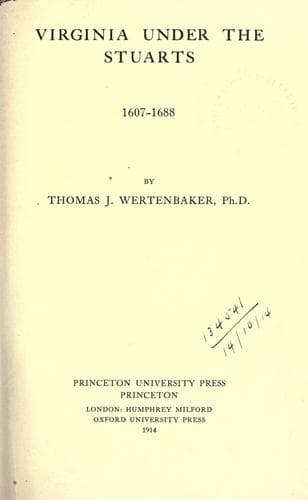
Virginia under the Stuarts 1607-1688Wertenbaker, Thomas Jefferson
History
Virginia under the Stuarts 1607-1688
Wertenbaker, Thomas Jefferson
Virginia -- History -- Colonial period, ca. 1600-1775
In August, 1611, Sir Thomas Gates, returning to assume the command of
the colony, pushed vigorously the work upon the new settlement.[90] Dale
was sent up the river with no less than three hundred men, with
directions to construct houses and fortifications. The settlers, working
with new life and vigor in the more wholesome air of the upper James,
soon rendered the place almost impregnable to attack from the Indians.
They cut a ditch across the narrow neck of the peninsula, and fortified
it with high palisades. To prevent a sudden raid by the savages in
canoes from the other shore, five strong block houses were built at
intervals along the river bank. Behind these defenses were erected a
number of substantial houses, with foundations of brick and frame
superstructures. Soon a town of three streets had been completed, more
commodious and far more healthful than Jamestown.[91]
When this work had been completed, Dale led a force of men across to the
south bank of the river and took possession of the entire peninsula
lying between the Appomattox and the James. An Indian settlement just
below Turkey Island bend was attacked and destroyed, and the savages
driven away. The English built a palisade over two miles long and
reinforced at intervals with forts and block houses, from the James at
Henrico to the falls of the Appomattox. These fortifications secured
from the attacks of the savages "many miles of champion and woodland",
and made it possible for the English to lay out in safety several new
plantations or hundreds. Dale named the place Bermuda, "by reason of the
strength of the situation".
Here, for the first time, something like prosperity came to the colony.
Although the "sicknesse" was not entirely eliminated even at Henrico,
the percentage of mortality was greatly reduced. Soon there were in
Virginia several hundred persons that had lived through the fatal months
of June, July and August and were thoroughly "seasoned" or immune to the
native disorders. Not until 1618, when the settlers, in their greed for
land suitable for the cultivation of tobacco, deserted their homes on
the upper James for the marshy ground of the lower country, and new,
unacclimated persons began arriving in great numbers, did the pestilence
again assume its former proportions.
Public-domain text, read in full here on John Shaqi.
Reviews
Reviews
No reviews yet
Be the first to share your thoughts on this work.
Join the Discussion
Join the discussion
Sign in to leave a comment or review.
Sign InorCreate an account