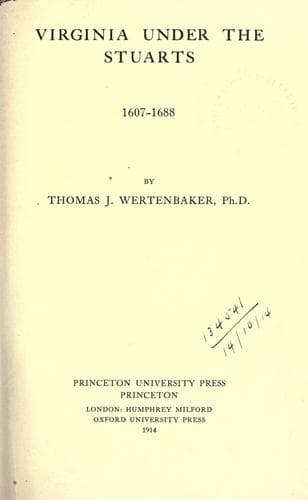
Virginia under the Stuarts 1607-1688Wertenbaker, Thomas Jefferson
History
Virginia under the Stuarts 1607-1688
Wertenbaker, Thomas Jefferson
Virginia -- History -- Colonial period, ca. 1600-1775
Thus protected from the ravages of disease and from the assaults of the
savages, Dale's men were able to turn their attention to the cultivation
of the soil. Soon they were producing an annual crop of corn sufficient
to supply their more pressing needs. And it was well for them that they
could become, to some extent, independent of England, for the London
Company, at last discouraged by continued misfortune, was often remiss
in sending supplies. Clothing became exceedingly scarce. Not only were
the gaudy uniforms of De la Warr's time lacking, but many persons were
forced to imitate the savages by covering themselves with skins and
furs.[92] The Company, however, succeeded in obtaining for them from the
King many suits of old armor that were of great value in their wars with
the savages. Coats of mail and steel that had become useless on the
battlefields of Europe and had for years been rusting in the Tower of
London, were polished up and sent to Virginia. Thus, behind the
palisades of Henrico or in the fort at Jamestown one might have seen at
this time soldiers encased in armor that had done service in the days of
Richard III and Henry VII.[93]
The London Company, when they sent Sir Thomas Gates to Virginia with the
letters patent of 1609, gave directions that the utmost severity should
be used in putting an end to lawlessness and confusion. Gates, who had
fought against the Spaniards in the Netherlands and had the soldier's
dislike of insubordination, was well suited to carry their wishes into
effect. No sooner had he arrived from Devil's Island in 1610 than he
posted in the church at Jamestown certain laws, orders and instructions
which he warned the people they must obey strictly.[94] These laws were
exceedingly severe. It was, for instance, ordered that "every man and
woman daly twice a day upon the first towling of the Bell shall upon the
working daies repaire into the Church, to hear divine Service upon pain
of losing his or her dayes allowance for the first omission, for the
second to be whipt, and for the third to be condemned to the Gallies for
six Months". Again, it was decreed that "no man shall give any
disgracefull words, or commit any act to the disgrace of any person ...
upon paine of being tied head and feete together, upon the guard everie
night for the space of one moneth.... No man shall dare to kill, or
destroy any Bull, Cow, Calfe, Mare, Horse, Colt, Goate, Swine, Cocke,
Henne, Chicken, Dogge, Turkie, or any tame Cattel, or Poultry, of what
condition soever, ... without leave from the Generall, upon paine of
death.... There shall no man or woman ... dare to wash any unclean
linnen ... within the Pallizadoes, ... nor rench, and make clean, any
kettle, pot or pan ... within twenty foote of the olde well ... upon
pain of whipping."[95]
Public-domain text, read in full here on John Shaqi.
Reviews
Reviews
No reviews yet
Be the first to share your thoughts on this work.
Join the Discussion
Join the discussion
Sign in to leave a comment or review.
Sign InorCreate an account