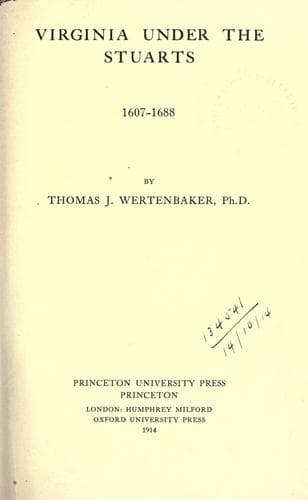
Virginia under the Stuarts 1607-1688Wertenbaker, Thomas Jefferson
History
Virginia under the Stuarts 1607-1688
Wertenbaker, Thomas Jefferson
Virginia -- History -- Colonial period, ca. 1600-1775
But James had no desire to arouse the hostility of Philip III. Despite
religious differences, despite the hatred of the English for the
Spaniards, he had reversed the policy of Elizabeth by cultivating the
friendship of these hereditary enemies. And so wedded was he to this
design, that later, when his son-in-law, Frederick of the Palatinate,
was being overwhelmed by a coalition of Catholic nations, he refused to
affront Spain by coming to his rescue. Yet he knew that Philip
considered America his own, and would resent any attempt of the English
to establish colonies on its shores. So the crafty James resolved to
disguise the founding of a royal colony under the guise of a private
venture.[117] If the Spaniards complained of the occupation of their
territory, he could free himself from blame by placing the
responsibility upon the London Company. "If it take not success," his
advisors told the King, "it is done by their owne heddes. It is but the
attempt of private gentlemen, the State suffers noe losse, noe
disreputation. If it takes success, they are your subjects, they doe it
for your service, they will lay all at your Majesty's feet and interess
your Majesty therein."[118]
James was quite liberal in granting charters to those that had
undertaken the settlement, and he encouraged them as much as was
consistent with his friendship for Spain. It was truly written of him
after his death, "Amongst the ... workes of the late Kinge, there was
none more eminent, than his gracious inclination ... to advance and sett
forward a New Plantation in the New World."[119] That he was deeply
interested in the undertaking is shown most strikingly by his consent to
the establishment of the Puritans in America. James hated the tenets of
Calvin from the depths of his soul, and could have no desire to see them
infect the English settlements in America, yet his solicitude for the
welfare of the colony induced him to yield to the request of the
Pilgrims for permission to settle there. How much greater was his
foresight than that of Louis XIV, who, by refusing to allow the
persecuted Huguenots to settle in any part of his domains, deprived the
French colonies of what might have been their most numerous and valuable
recruits! When some of the leading men of the London Company pleaded
with James for the Puritans, the King lent a ready ear. He was asked to
allow them "liberty of conscience under his ... protection in America;
where they would endeavour the advancement of his Majesty's dominions,
and the enlargement of the interests of the Gospel". James replied that
it was "a good and honest motion". He refused to tolerate them by public
authority and would not confirm under the broad seal their petition for
leave to worship as they chose, but he let it be understood that they
were not to be molested in their new homes in any way.[120] And in this
promise they finally decided to put their trust, feeling that "if
Public-domain text, read in full here on John Shaqi.
Reviews
Reviews
No reviews yet
Be the first to share your thoughts on this work.
Join the Discussion
Join the discussion
Sign in to leave a comment or review.
Sign InorCreate an account