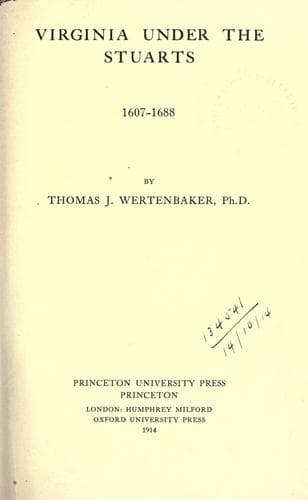
Virginia under the Stuarts 1607-1688Wertenbaker, Thomas Jefferson
History
Virginia under the Stuarts 1607-1688
Wertenbaker, Thomas Jefferson
Virginia -- History -- Colonial period, ca. 1600-1775
The body at once claimed and made good its right to exclude Burgesses
who they thought were not entitled to seats. The Speaker himself raised
an objection to admitting the representatives of Warde's plantation,
because that settlement had been made without a commission from the
London Company. But Captain Warde promised to secure a patent as soon as
possible, and the objection was waived. The Assembly refused absolutely,
however, to seat the Burgesses from Martin's Hundred. Captain Martin had
been one of the first Council for Virginia, and as a reward for his long
services had been granted privileges that rendered him almost
independent of the government at Jamestown. He was summoned before the
Assembly and requested to relinquish these extraordinary rights, but he
refused to do so. "I hold my patent," he said, "for my service don,
which noe newe or late comer can meritt or challenge."[145] So the
Assembly, feeling that it would be mockery to permit the Burgesses from
Martin's Hundred to assist in the making of laws which their own
constituents, because of their especial charter, might with impunity
disobey, refused to admit them.[146]
The legislative powers granted the Virginia Assembly in the Magna
Charta, and continued with slight alterations after the revocation of
the charter of the London Company, were very extensive. The Assembly
could pass laws dealing with a vast variety of matters appertaining to
the safety and welfare of the colony. Statutes were enacted in the
session of 1619 touching upon Indian affairs, the Church, land patents,
the relations of servants and landlords, the planting of crops, general
morality in Virginia, the price of tobacco, foreign trade, etc. The
collected laws of the entire colonial period fill many volumes, and
cover a vast variety of subjects. But there were three things which
limited strictly the Assembly's field of action. They must pass no
statutes contravening first, the laws of England; secondly, the
charters; thirdly, the instructions sent them by the London Company.
When the colony passed into the hands of the King, all statutes were
forbidden that conflicted with the charters, or with the instructions of
the Crown. These restrictions lasted during the entire colonial period,
but they were not always carefully regarded. The Company, and later the
King, retained two ways of nullifying legislation which was
unauthorized, or was distasteful to them. First, there was the veto of
the Governor. As the guardian of the interests of England and his
monarch, this officer could block all legislation. Secondly, the
Company, and later the King, could veto laws even though the Governor
had consented to them.
Public-domain text, read in full here on John Shaqi.
Reviews
Reviews
No reviews yet
Be the first to share your thoughts on this work.
Join the Discussion
Join the discussion
Sign in to leave a comment or review.
Sign InorCreate an account