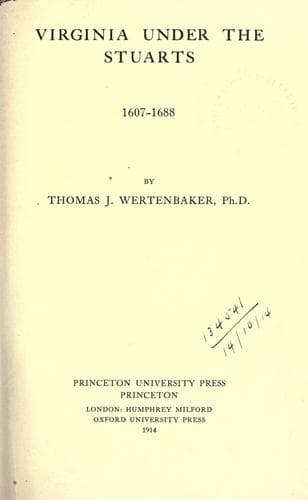
Virginia under the Stuarts 1607-1688Wertenbaker, Thomas Jefferson
History
Virginia under the Stuarts 1607-1688
Wertenbaker, Thomas Jefferson
Virginia -- History -- Colonial period, ca. 1600-1775
But the most important power exercised by the Assembly was its control
over taxation in Virginia. In the very first session it made use of this
privilege by ordering, "That every man and manservant of above 16 years
of age shall pay into the handes and Custody of the Burgesses of every
Incorporation and plantation one pound of the best Tobacco".[147] The
funds thus raised were utilized for the payment of the officers of the
Assembly.
The levy by the poll, here used, was continued for many years, and
became the chief support of the government. As the colony grew, however,
and the need for greater revenues was felt, customs duties and other
forms of taxation were resorted to. Large sums were raised by an export
duty upon tobacco. At times tariffs were placed upon the importation of
liquors, slaves and other articles. But these duties had to be used with
great care, for the carrying of the colony was done chiefly by English
merchants, and Parliament would permit nothing detrimental to their
interests.
The Assembly claimed the exclusive right to levy general taxes. The
Governor and Council time and again tried to wrest this privilege from
them, but never with success.[148] The Burgesses, realizing that their
hold upon the exchequer was the chief source of their power, were most
careful never to relinquish it. From time to time the Governors sought
to evade this restraint by levying taxes under the guise of fees. But
this expedient invariably excited intense irritation, and yielded a
revenue so small that most Governors thought it best to avoid it
entirely. Of more importance were the quit-rents, a tax on land, paid to
the King by all freeholders. But this was frequently avoided, and,
except at rare intervals, the funds raised by it were left in Virginia
to be expended for local purposes. The greatest blow to the power of the
Burgesses was struck by the King in 1680, when he forced through the
Assembly a law granting to the government a perpetual income from the
export duty on tobacco. This revenue, although not large, was usually
sufficient to pay the Governor's salary, and thus to render him less
dependent upon the Assembly. Finally, it must not be forgotten that the
English government, although it refrained from taxing the colony
directly, imposed an enormous indirect tax by means of a tariff upon
tobacco brought into England. These duties were collected in England,
but there can be no doubt that the incidence of the tax rested partly
upon the Virginia planters. Despite these various duties, all levied
without its consent, the Assembly exercised a very real control over
taxation in Virginia, and used it as an effective weapon against the
encroachments of the Governors.
Public-domain text, read in full here on John Shaqi.
Reviews
Reviews
No reviews yet
Be the first to share your thoughts on this work.
Join the Discussion
Join the discussion
Sign in to leave a comment or review.
Sign InorCreate an account