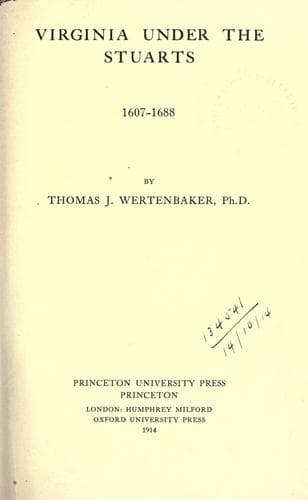
Virginia under the Stuarts 1607-1688Wertenbaker, Thomas Jefferson
History
Virginia under the Stuarts 1607-1688
Wertenbaker, Thomas Jefferson
Virginia -- History -- Colonial period, ca. 1600-1775
The executive powers entrusted to the Council were also of very great
importance. The Governor was compelled by his instructions to secure its
assistance and consent in the most important matters. And since the
chief executive was always a native of England, and often entirely
ignorant of conditions in the colony, he was constantly forced to rely
upon the advice of his Council. This tendency was made more pronounced
by the frequent changes of Governors that marked the last quarter of the
seventeenth century. So habitually did the Council exercise certain
functions, not legally within their jurisdiction, that they began to
claim them as theirs by right. And the Governor was compelled to respect
these claims as scrupulously as the King of England respects the
conventions that hedge in and limit his authority.
Before the end of the seventeenth century the Council had acquired
extraordinary influence in the government. With the right to initiate
and to block legislation, with almost complete control over the
judiciary, with great influence in administrative matters, it
threatened to become an oligarchy of almost unlimited power.
But it must not be supposed that the influence of the Council rendered
impotent the King's Governor. Great powers were lodged in the hands of
this officer by his various instructions and commissions. He was
commander of the militia, was the head of the colonial church, he
appointed most of the officers, attended to foreign affairs, and put the
laws into execution. His influence, however, resulted chiefly from the
fact that he was the representative of the King. In the days of Charles
I, in the Restoration Period and under James II, when the Stuarts were
combating liberal institutions, both in England and in the colonies, the
Governor exercised a powerful and dangerous control over affairs in
Virginia. But after the English Revolution his power declined. As the
people of England no longer dreaded a monarch whose authority now rested
solely upon acts of Parliament, so the Virginians ceased to fear his
viceroy.
The powers officially vested in the Governor were by no means solely
executive. He frequently made recommendations to the Assembly, either in
his own name or the name of the King, and these recommendations at times
assumed the nature of commands. If the Burgesses were reluctant to obey,
he had numerous weapons at hand with which to intimidate them and whip
them into line. Unscrupulous use of the patronage and threats of the
King's dire displeasure were frequently resorted to. The Governor
presided over the upper house, and voted there as any other member.
Moreover, he could veto all bills, even those upon which he had voted in
the affirmative in the Council. Thus he had a large influence in shaping
the laws of the colony, and an absolute power to block all legislation.
Public-domain text, read in full here on John Shaqi.
Reviews
Reviews
No reviews yet
Be the first to share your thoughts on this work.
Join the Discussion
Join the discussion
Sign in to leave a comment or review.
Sign InorCreate an account