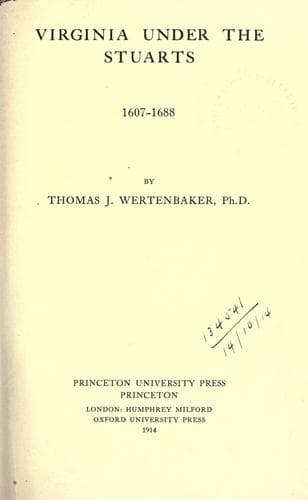
Virginia under the Stuarts 1607-1688Wertenbaker, Thomas Jefferson
History
Virginia under the Stuarts 1607-1688
Wertenbaker, Thomas Jefferson
Virginia -- History -- Colonial period, ca. 1600-1775
From the very first the General Assembly showed itself an energetic and
determined champion of the rights of the people. Time and again it
braved the anger of the Governor and of the King himself, rather than
yield the slightest part of its privileges. During the decade preceding
the English Revolution only the heroic resistance of this body saved the
liberal institutions of the colony from destruction at the hands of
Charles II and James II.
The General Assembly was not only a legislative body, it was also a
court of justice, and for many years served as the highest tribunal of
the colony. The judicial function was entrusted to a joint committee
from the two houses, whose recommendations were usually accepted without
question. Since this committee invariably contained more Burgesses than
Councillors, the supreme court was practically controlled by the
representatives of the people. During the reign of Charles II, however,
the Assembly was deprived of this function by royal proclamation, and
the judiciary fell almost entirely into the hands of the Governor and
Council.
The General Assembly consisted of two chambers--the House of Burgesses
and the Council. In the early sessions the houses sat together and
probably voted as one body.[149] Later, however, they were divided and
voted separately. The Burgesses, as time went on, gradually increased in
numbers until they became a large body, but the Council was always
small.
The Councillors were royal appointees. But since the King could not
always know personally the prominent men of the colony, he habitually
confirmed without question the nominations of the Governor. The members
of the Council were usually persons of wealth, influence and ability. As
they were subject to removal by the King and invariably held one or more
lucrative governmental offices, it was customary for them to display
great servility to the wishes of his Majesty or of the Governor. It was
very unusual for them to oppose in the Assembly any measure recommended
by the King, or in accord with his expressed wishes. Although the
Councillors were, with rare exceptions, natives of Virginia, they were
in no sense representative of the people of the colony.
As the upper house of the Assembly, the Council exercised a powerful
influence upon legislation. After the separation of the chambers their
consent became necessary for the passage of all bills, even money bills.
Their legislative influence declined during the eighteenth century,
however, because of the growing spirit of liberalism in Virginia, and
the increasing size of the House of Burgesses.
Public-domain text, read in full here on John Shaqi.
Reviews
Reviews
No reviews yet
Be the first to share your thoughts on this work.
Join the Discussion
Join the discussion
Sign in to leave a comment or review.
Sign InorCreate an account