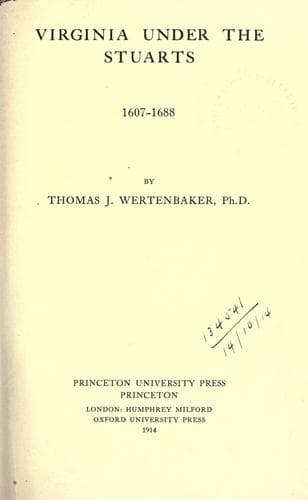
Virginia under the Stuarts 1607-1688Wertenbaker, Thomas Jefferson
History
Virginia under the Stuarts 1607-1688
Wertenbaker, Thomas Jefferson
Virginia -- History -- Colonial period, ca. 1600-1775
His plans were laid with great cunning. Although thousands of natives
knew of the design, no warning reached the white men until the very eve
of the massacre. While Opechancanough was preparing this tremendous
blow, he protested in the strongest terms his perpetual good will and
love, declaring that the sky would fall before he would bring an end to
the peace.[175] In order to lull the suspicions of the planters, "even
but two daies before the massacre", he guided some of them "with much
kindnesse through the woods, and one Browne that lived among them to
learne the language", he sent home to his master. The evening before the
attack the Indians came as usual to the plantations with deer, turkeys,
fish, fruits and other provisions to sell.[176]
That night, however, a warning was received, which although too late to
save the most remote settlements, preserved many hundreds from the
tomahawk. Chanco, an Indian boy who had been adopted by an Englishman
named Race, revealed the entire plot to his master. The man secured his
house, and rowed away before dawn in desperate haste to Jamestown, to
give warning to the Governor. "Whereby they were prevented, and at such
other plantations as possibly intelligence could be given."[177]
The assault of the savages was swift and deadly. In all parts of the
colony they fell upon the settlers, and those that had received no
warning were, in most cases, butchered before they could suspect that
harm was intended. Sometimes the Indians sat down to breakfast with
their victims, "whom immediately with their owne tooles they slew most
barbarously, not sparing either age or sex, man woman or childe".[178]
Many were slain while working in the fields; others were trapped in
their houses and butchered before they could seize their weapons. The
savages, "not being content with their lives,... fell againe upon the
dead bodies, making as well as they could a fresh murder, defacing,
dragging, and mangling their dead carkases into many peeces".[179]
That the plot was so successful was due to the completeness of the
surprise, for where the English made the least resistance the savages
were usually beaten off. A planter named Causie, when attacked and
wounded and surrounded by the Indians, "with an axe did cleave one of
their heads, whereby the rest fled and he escaped; for they hurt not any
that did either fight or stand upon their guard. In one place where they
had warning of it, (they) defended the house against sixty or more that
assaulted it."[180]
Public-domain text, read in full here on John Shaqi.
Reviews
Reviews
No reviews yet
Be the first to share your thoughts on this work.
Join the Discussion
Join the discussion
Sign in to leave a comment or review.
Sign InorCreate an account