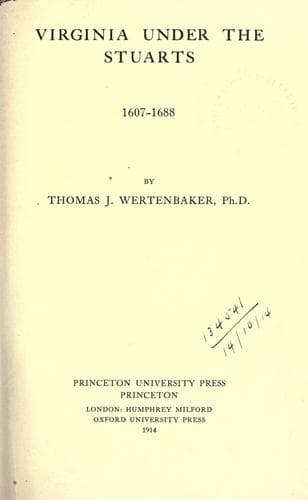
Virginia under the Stuarts 1607-1688Wertenbaker, Thomas Jefferson
History
Virginia under the Stuarts 1607-1688
Wertenbaker, Thomas Jefferson
Virginia -- History -- Colonial period, ca. 1600-1775
At the plantation of a Mr. Harrison, where there were gathered seven men
and eighteen or nineteen women and children, the savages set fire to a
tobacco house and then came in to tell the men to quench it. Six of the
English, not suspecting treachery, rushed out, and were shot full of
arrows. Mr. Thomas Hamor, the seventh man, "having finished a letter he
was writing, followed after to see what was the matter, but quickly they
shot an arrow in his back, which caused him to returne and barricade up
the dores, whereupon the Salvages set fire to the house. But a boy,
seizing a gun which he found loaded, discharged it at random. At the
bare report the enemy fled and Mr. Hamor with the women and children
escaped."[181] In a nearby house, a party of English under Mr. Hamor's
brother, were caught by the Indians without arms, but they defended
themselves successfully with spades, axes and brickbats.[182]
One of the first to fall was Reverend George Thorpe, a member of the
Virginia Council, and a man of prominence in England.[183] Leaving a
life of honor and ease, he had come to Virginia to work for the
conversion of the Indians. He had apparently won the favor of
Opechancanough, with whom he often discoursed upon the Christian
religion. At the moment of his murder, his servant, perceiving the
deadly intent of the savages, gave him warning, but his gentle nature
would not permit him to believe harm of those whom he had always
befriended, and he was cut down without resistance.[184]
The barbarous king failed in his design to destroy the English race in
Virginia, but the massacre was a deadly blow to the colony. No less than
three hundred and fifty-seven persons were slaughtered, including six
Councillors. The news of the disaster brought dismay to the London
Company. For a while they attempted to keep the matter a secret, but in
a few weeks it was known all over England. Although the massacre could
not have been foreseen or prevented, it served as a pretext for numerous
attacks upon Sandys and the party which supported him. It discouraged
many shareholders and made it harder to secure settlers for the colony.
Even worse was the effect in Virginia. The system of farming in
unprotected plantations, which had prevailed for some years, had now to
be abandoned and many settlements that were exposed to the Indians were
deserted. "We have not," wrote the Assembly, "the safe range of the
Country for the increase of Cattle, Swyne, etc; nor for the game and
fowle which the country affords in great plentye; besides our duties to
watch and warde to secure ourselves and labor are as hard and chargeable
as if the enemy were at all times present."[185]
Public-domain text, read in full here on John Shaqi.
Reviews
Reviews
No reviews yet
Be the first to share your thoughts on this work.
Join the Discussion
Join the discussion
Sign in to leave a comment or review.
Sign InorCreate an account