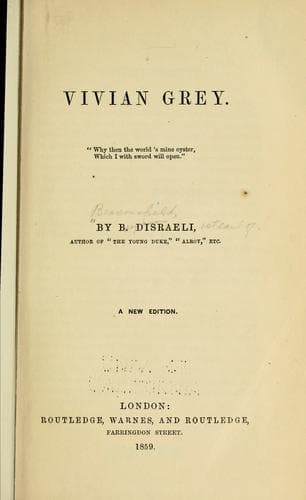
Vivian GreyDisraeli, Benjamin, Earl of Beaconsfield
ReligionIslamic
Vivian Grey
Disraeli, Benjamin, Earl of Beaconsfield
Bildungsromans; British -- Europe -- Fiction; Political fiction; Politicians -- Fiction; Young men -- Fiction
“You see, my Lord,” Stapylton would say, pointing to a dark, dingy
picture of a gentleman in a rich court dress, “you see, my Lord, it is
not in a very good light, and it certainly is a very dark picture, by
Hudson; all Hudson’s pictures were dark. But if I were six inches
taller, and could hold the light just there, I think your Lordship would
be astonished at the resemblance; but it’s a dark picture, certainly it
is dark; all Hudson’s pictures were.”
CHAPTER XIV
The Cavaliers have left the ancient Hall, and the old pictures frown
only upon empty tables. The Marquess immediately gained a seat by Mrs.
Million, and was soon engrossed in deep converse with that illustrious
lady. In one room, the most eminent and exclusive, headed by Mrs. Felix
Lorraine, were now winding through the soothing mazes of a slow waltz,
and now whirling, with all the rapidity of Eastern dervishes, to true
double Wien time. In another saloon, the tedious tactics of quadrilles
commanded the exertions of less civilised beings: here Liberal Snake,
the celebrated political economist, was lecturing to a knot of alarmed
country gentlemen; and there an Italian improvisatore poured forth to an
admiring audience all the dulness of his inspiration. Vivian Grey was
holding an earnest conversation in one of the recesses with Mr.
Stapylton Toad. He had already charmed that worthy by the deep interest
which he took in everything relating to elections and the House of
Commons, and now they were hard at work on the Corn Laws. Although they
agreed upon the main points, and Vivian’s ideas upon this important
subject had, of course, been adopted after studying Mr. Toad’s “most
luminous and convincing pamphlet,” still there were a few minor points
on which Vivian “was obliged to confess” that “he did not exactly see
his way.” Mr. Toad was astonished, but argumentative, and, of course, in
due time, had made a convert of his companion; “a young man,” as he
afterwards remarked to Lord Mounteney, “in whom he knew not which most
to admire, the soundness of his own views, or the candour with which he
treated those of others.” If you wish to win a man’s heart, allow him to
confute you.
“I think, Mr. Grey, you must admit that my definition of labour is the
correct one?” said Mr. Toad, looking earnestly in Vivian’s face, his
finger just presuming to feel a button.
“That exertion of mind or body which is not the involuntary effect of
the influence of natural sensations,” slowly repeated Vivian, as if his
whole soul was concentrated in each monosyllable. “Y-e-s, Mr. Toad, I do
admit it.”
“Then, my dear sir, the rest follows of course,” triumphantly exclaimed
the member; “don’t you see it?”
“Although I admit the correctness of your definition, Mr. Toad, I am not
free to confess that I am ex-act-ly convinced of the soundness of your
conclusion,” said Vivian, in a musing mood.
“But, my dear sir, I am surprised that you don’t see that--”
Public-domain text, read in full here on John Shaqi.
Reviews
Reviews
No reviews yet
Be the first to share your thoughts on this work.
Join the Discussion
Join the discussion
Sign in to leave a comment or review.
Sign InorCreate an account