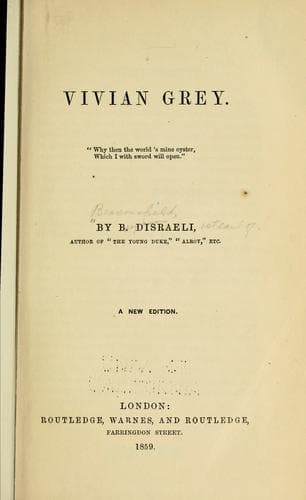
Vivian GreyDisraeli, Benjamin, Earl of Beaconsfield
ReligionIslamic
Vivian Grey
Disraeli, Benjamin, Earl of Beaconsfield
Bildungsromans; British -- Europe -- Fiction; Political fiction; Politicians -- Fiction; Young men -- Fiction
“Stop, Mr. Toad,” eagerly exclaimed Vivian; “I see my error. I
misconceived your meaning: you are right, sir; your definition
is correct.”
“I was confident that I should convince you, Mr. Grey.”
“This conversation, I assure you, Mr. Toad, has been to me a peculiarly
satisfactory one. Indeed, sir, I have long wished to have the honour of
making your acquaintance. When but a boy, I remember, at my father’s
table, the late Marquess of Almack’s--”
“Yes, Mr. Grey.”
“One of the ablest men, Mr. Toad, after all, that this country ever
produced.”
“Oh, poor dear man!”
“I remember his observing to a friend of mine, who was at that time
desirous of getting into the House: ‘Hargrave,’ said his Lordship, ‘if
you want any information upon points of practical politics;’ that was
his phrase; you remember, Mr. Toad, that his Lordship was peculiar in
his phrases?”
“Oh! yes, poor dear man; but you were observing, Mr. Grey--”
“Ay, ay! ‘If you want any information,’ said his Lordship, ‘on such
points, there is only one man in the kingdom whom you should consult,
and he is one of the soundest heads I know, and that is Stapylton Toad,
the member for Mounteney;’ you know you were in for Mounteney then,
Mr. Toad.”
“I was, and accepted the Chilterns to make room for Augustus Clay,
Ernest Clay’s brother, who was so involved, that the only way to keep
him out of the House of Correction was to get him into the House of
Commons. But the Marquess said so, eh?”
“Ay, and much more, which I scarcely can remember;” and then followed a
long dissertation on the character of the noble statesman, and his views
as to the agricultural interest, and the importance of the agricultural
interest; and then a delicate hint was thrown out as to “how delightful
it would be to write a pamphlet together” on this mighty agricultural
interest; and then came a panegyric on the character of country
gentlemen, and English yeomen, and the importance of keeping up the old
English spirit in the peasantry, &c. &c. &c. &c.; and then, when Vivian
had led Mr. Toad to deliver a splendid and patriotic oration on this
point, he “just remembered (quite apropos to the sentiments which Mr.
Toad had just delivered, and which, he did not hesitate to say, ‘did
equal honour to his head and heart’) that there was a little point,
which, if it was not trespassing too much on Mr. Toad’s attention, he
would just submit to him;” and then he mentioned poor John Conyers’
case, although “he felt convinced, from Mr. Toad’s well-known benevolent
character, that it was quite unnecessary for him to do so, as he felt
assured that it would be remedied immediately it fell under his
cognisance; but then Mr. Toad had really so much business to transact,
that perhaps these slight matters might occasionally not be submitted to
him,” &c. &c. &c.
What could Stapylton Toad do but, after a little amiable grumbling about
“bad system and bad precedent,” promise everything that Vivian
Grey required?
Public-domain text, read in full here on John Shaqi.
Reviews
Reviews
No reviews yet
Be the first to share your thoughts on this work.
Join the Discussion
Join the discussion
Sign in to leave a comment or review.
Sign InorCreate an account