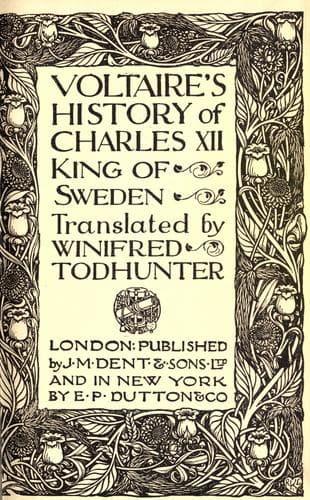
Voltaire's history of Charles XII, king of SwedenVoltaire
Philosophy
Voltaire's history of Charles XII, king of Sweden
Voltaire
Charles XII, King of Sweden, 1682-1718
The revenue of the Czar was inconsiderable, compared with the immense
size of his empire. It never exceeded twenty-four millions, reckoning
the mark as £50, as we do at the present moment; but, after all, only
he is rich who can do great deeds. Russia is not densely populated,
though the women are prolific and the men are strong. Peter himself,
by the very civilization of his empire, contributed to its population.
The causes of the fact that there are still vast deserts in this great
stretch of the continent are to be sought in frequent recruiting for
unsuccessful wars, the transporting of nations from the Caspian to
the Baltic, the destruction of life in the public works, the ravages
wrought by disease (three-quarters of the children dying of small-pox),
and the sad result of a means of government long savage, and barbarous
even in its civilization. The present population of Russia consists of
500,000 noble families, 200,000 lawyers, rather more than 5,000,000
“bourgeois” and peasants paying a kind of poll-tax, and 600,000 men in
the provinces conquered from the Swedes; so that this immense realm
does not contain more than 14,000,000 men; that is to say, two-thirds
of the population of France.
The Czar Peter, having transformed the manners, laws, militia, and
the very face of his country, wished also to take a prominent part
in commerce, which brings both riches to a State and advantages to
the whole world. He intended to make Russia the centre of Asian and
European trade. The Volga, Tanais, and Duna were to be united by
canals, of which he drew the plans, and new ways were to be opened
from the Baltic to the Euxine and the Caspian, and from these to the
Northern Ocean.
In the year 1700 he decided to build on the Baltic a port which should
be the mart of the North, and a town which should be the capital
of his empire, because the port of Archangel, ice-bound for nine
months in the year, and the access to which necessitated a long and
dangerous circuit, did not seem to him convenient. Already he was
seeking a passage to China through the seas of the north-east, and the
manufactures of Paris and of Pekin were to enrich his new town.
A road of 754 versts, made across marshes which had to be first filled,
led from Moscow to his new town. Most of his projects were carried
out by his own hand, and two Empresses who succeeded him successively
carried out his policy whenever practicable, and only abandoned the
impossible.
He made tours throughout his empire whenever he was not engaged in
active warfare. But he travelled as lawgiver and natural philosopher.
He carefully investigated natural conditions everywhere, and tried
to correct and to perfect. He himself plumbed rivers and seas, had
locks made, visited the timber-yards, examined mines, assayed metals,
planned accurate maps, and worked at them with his own hand.
Public-domain text, read in full here on John Shaqi.
Reviews
Reviews
No reviews yet
Be the first to share your thoughts on this work.
Join the Discussion
Join the discussion
Sign in to leave a comment or review.
Sign InorCreate an account