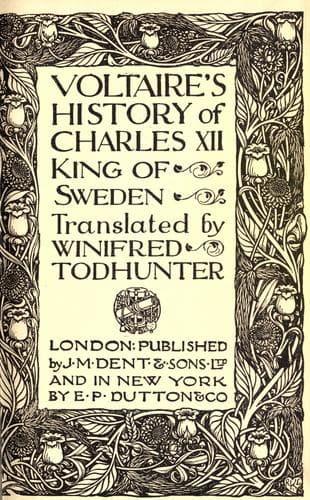
Voltaire's history of Charles XII, king of Sweden — John Shaqi
Voltaire's history of Charles XII, king of SwedenVoltaire
Philosophy
Voltaire's history of Charles XII, king of Sweden
Voltaire
Charles XII, King of Sweden, 1682-1718
He built, in a desolate district, the imperial town of Petersburg,
which, at the present day, contains 60,000 houses, and where there has
arisen in our day a brilliant Court, and where the greatest luxury is
to be had. He built the port of Cronstadt on the Neva, Sainte-Croix on
the frontiers of Persia, and forts in the Ukraine and in Siberia, docks
at Archangel, Petersburg, Astrakan, and at Azov; besides arsenals and
hospitals. His own residences he built small and in bad style, but his
public buildings were magnificent and imposing. The sciences, which in
other parts have been the slow product of centuries, were, by his care,
introduced into his empire in full perfection. He made an academy,
modelled on the famous institutions of Paris and London; at great
expense men like Delisle, Bilfinger, Hermann, Bernoulli, were summoned
to Petersburg. This academy is still in existence, and is now training
Russian scholars.
He compelled the younger members of the nobility to travel to gain
culture, and to return to Russia polished by foreign good breeding.
I have met young Russians who were quite men of the world, and
well-informed to boot.
It is shocking to realize that this reformer lacked the cardinal virtue
of humanity. With so many virtues he was yet brutal in his pleasures,
savage in his manner, and barbarous in seeking revenge. He civilized
his people, but remained savage himself. He carried out his sentences
with his own hands, and at a debauch at table he displayed his skill
in cutting off heads. There are in Africa kings who shed the blood
of their subjects with their own hands, but these monarchs pass for
barbarians. The death of one of his sons, who ought to have been
punished or disinherited, would make his memory odious, if the good he
did his subjects did not almost atone for his cruelty to his own family.
Such a man was Peter the Czar, and his great plans were only sketched
in outline when he united with the kings of Poland and Denmark against
a child whom they all despised.
The founder of Russia resolved to be a conqueror; he believed the task
an easy one, and felt that a war so well launched would help him in all
his projects. The art of war was a new art in which his people needed
lessons.
Besides, he wanted a port on the east side of the Baltic for the
execution of his great plans. He needed Ingria, which lies to the
north-east of Livonia. The Swedes possessed it, and it must be seized
from them. His ancestors, again, had had rights over Ingria, Estonia,
and Livonia; it seemed the right time to revive these claims, which not
only dated from a hundred years back, but had also been annulled by
treaties. He therefore concluded a treaty with the King of Poland to
take from Sweden the districts which lie between the Gulf of Finland,
the Baltic, Poland and Russia.
BOOK II
BOOK II
Public-domain text, read in full here on John Shaqi.
Reviews
Reviews
No reviews yet
Be the first to share your thoughts on this work.
Join the Discussion
Join the discussion
Sign in to leave a comment or review.
Sign InorCreate an account