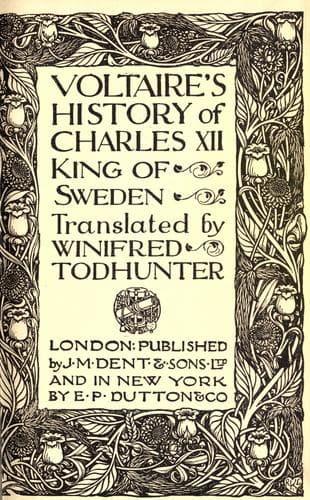
Voltaire's history of Charles XII, king of SwedenVoltaire
Philosophy
Voltaire's history of Charles XII, king of Sweden
Voltaire
Charles XII, King of Sweden, 1682-1718
The King of Sweden had great boats made, after a new model, so that the
sides were far higher than ordinary, and could be let down and drawn up
like a drawbridge. When raised they protected the troops they carried,
and when let down they formed a bridge to land by.
He also employed another artifice. Having noticed that the wind blew
straight from the north, where his troops lay, to the south, where his
enemies were encamped, he fired a large heap of wet straw, which spread
a thick smoke over the river and prevented the Saxons from seeing his
troops, or guessing at his actions. Under cover of this cloud he sent
out boats filled with smoking straw, so that the cloud increased, and
being right in the enemy’s face, prevented them from knowing whether
the King had started on the passage or not. Meanwhile, he himself led
the execution of his scheme; and when he was in the middle of the
river, “Well,” he said, “the Dwina is going to be as kind to us as the
sea of Copenhagen; take my word for it, General, we shall beat them.”
He got to the other side in a quarter of an hour, and was vexed to see
three people leap to shore before him. He had his cannon landed at
once, and drew up his line without any opposition from the enemy, who
were blinded by the smoke. When the wind dispersed the smoke the Saxons
saw the King of Sweden already on his march against them. Marshal
Stenau lost not a moment, but at the first appearance of the Swedes
fell furiously upon them with the best part of his horse. The violent
shock coming upon the Swedes just as they were forming, threw them into
disorder. They gave way, were broken, and pursued up to the river. The
King of Sweden rallied them instantly in the midst of the stream, with
as much ease as if he were holding a review. Then his troops, marching
in closer formation than before, beat back Marshal Stenau, and advanced
into the plain. Stenau felt that his men were beginning to waver, and,
like a skilful commander, drew them off into a dry place flanked by
a marsh, and a wood where his artillery were posted. The advantage
of their position, and the time they had to recover their spirits,
restored the Swedes’ courage. Charles attacked at once with 15,000
men, while the Duke had about 12,000. The battle was hard fought
and bloody; the Duke had two horses killed under him; he three times
penetrated into the centre of the King’s guards, but at last, having
been unhorsed by a musket blow, his army fell into confusion, and he
disputed the field no longer. His cuirassiers carried him off from the
thick of the battle with difficulty, all bruised, and half dead, from
the horses’ feet, as they were trampling him.
Public-domain text, read in full here on John Shaqi.
Reviews
Reviews
No reviews yet
Be the first to share your thoughts on this work.
Join the Discussion
Join the discussion
Sign in to leave a comment or review.
Sign InorCreate an account