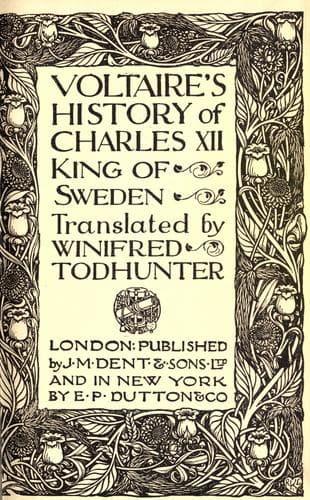
Voltaire's history of Charles XII, king of SwedenVoltaire
Philosophy
Voltaire's history of Charles XII, king of Sweden
Voltaire
Charles XII, King of Sweden, 1682-1718
“O thou, our perpetual consolation in all our adversities, great
Saint Nicholas, of infinite power, how have we offended thee in our
sacrifices, our genuflections, our bowings, our thanksgivings, that
thou hast thus forsaken us? We have implored thine assistance against
these terrible, insolent, savage, dreadful, invincible destroyers,
when, like lions and bears who have lost their young, they have
fallen upon us, terrified us, wounded us, slain us by thousands, who
are thy people. As it is impossible that this should have happened
without sorcery and witchcraft, we beseech thee, O great Nicholas,
to be our champion and standard-bearer, to deliver us from this band
of sorcerers, and to drive them from our coasts with the reward they
deserve.”
While the Russians were thus complaining of their defeat to St.
Nicholas, Charles XII returned thanks to God, and prepared himself for
fresh victories.
The King of Poland fully expected that his enemy, who had conquered
the Danes and Russians, would next turn his arms against him. He
made a firmer alliance with the Czar, and the two princes arranged
an interview at which they could agree on some policy. They met at
Brizen, a small town in Lithuania, without any of the formalities which
only delay business, and for which they were in no humour under the
circumstances. The princes of the North met with a familiarity which is
not yet the fashion in the south of Europe. Peter and Augustus passed
fifteen days together in pleasures which passed all bounds; for the
Czar, who had set himself to reform his kingdom, could not restrain his
own dangerous inclination to riotous living.
The King of Poland promised to furnish the Czar with 50,000 German
troops, which were to be hired from several princes, and which the
Czar was to pay. He, on the other hand, was to send 50,000 Russians to
Poland to be trained in the art of war, and was also to pay the King
of Poland 3,000,000 rixdollars within two years. Had this treaty been
carried out it might have been fatal to the King of Sweden. It was a
ready and sure way of making good soldiers of the Russians, and might
perhaps have forged irons for half Europe.
Charles XII set himself to prevent the King of Poland from getting the
benefit of this treaty. After passing the winter in Narva, he marched
into Livonia, to the very town of Riga which King Augustus had failed
to take. The Saxon troops were posted along the river Dwina, which is
very broad at this spot, and their task was to dispute the passage with
Charles, who lay on the other bank. The Saxons were not then commanded
by their Prince, who was at that time ill; but their leader was Marshal
Stenau, who was general; under him commanded Prince Ferdinand, Duke of
Courland, and the same Patkul, who, after having maintained his rights
on paper, defended his country against Charles sword in hand at the
peril of his life.
Public-domain text, read in full here on John Shaqi.
Reviews
Reviews
No reviews yet
Be the first to share your thoughts on this work.
Join the Discussion
Join the discussion
Sign in to leave a comment or review.
Sign InorCreate an account