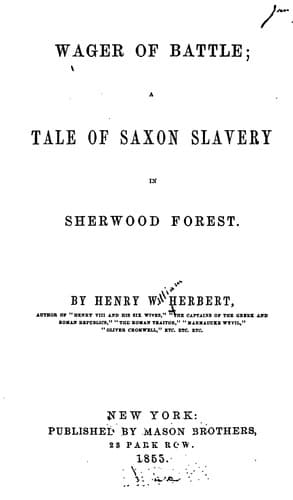
Wager of Battle: A Tale of Saxon Slavery in Sherwood ForestHerbert, Henry William
History
Wager of Battle: A Tale of Saxon Slavery in Sherwood Forest
Herbert, Henry William
Anglo-Saxons -- Fiction; Great Britain -- History -- Norman period, 1066-1154 -- Fiction; Sherwood Forest (England) -- Fiction
For some time past, as was known throughout all the region, Sir Philip
de Morville had been, if not actually at feud, at least on terms of
open enmity with the nobleman whose lands marched with his own on the
forest side, Sir Foulke d'Oilly--a man well-advanced in years, most of
which he had spent in constant marauding warfare, a hated oppressor
and tyrant to his tenantry and vassals, and regarded, among his Norman
neighbors and comrades, as an unprincipled, discourteous, and cruel
man.
With this man, recently, fresh difficulties had arisen concerning some
disputed rights of chase, and on a certain day, within a month after
the departure of Sir Yvo de Taillebois, the two nobles, meeting on the
debatable ground, while in pursuit of the chase, under very
aggravating circumstances, the hounds of both parties having fallen on
the scent of the same stag, high words passed--a few arrows were shot
by the retainers on both sides, Sir Philip's being much the more
numerous; a forester of Sir Foulke d'Oilly's train was slain; and, had
it not been for the extreme forbearance of De Morville, a conflict
would have ensued, which could have terminated only in the total
discomfiture of his rival and all his men.
This forbearance, however, effected no good end; for, before the
barons parted, some words passed between them in private, which were
not heard by any of their immediate followers, and the effect of which
was known only by the consequences which soon ensued.
On the following morning, at the break of day, before the earliest of
the serfs were summoned to their labors, the castle draw-bridge was
lowered, and Sir Philip rode forth on his destrier, completely armed,
but followed only by a single esquire in his ordinary attire.
The vizor of the knight's square-topped helmet was lowered, and the
mail-hood drawn closely over it. His habergeon of glittering
steel-rings, his mail-hose, fortified on the shoulders and at the
knees by plates of polished steel, called poldrons and splents, shone
like silver through the twilight; his triangular shield hung about his
neck, his great two-handed broad-sword from his left shoulder to his
heel, and his long steel-headed lance was grasped in his right hand;
none could doubt that he was riding forth to do battle, but it was
strange that he wore no surcoat of arms over his plain mail, that no
trumpet preceded, no banner was borne behind him, no retainers, save
that one unarmed man, in his garb of peace, followed the bridle of
their lord.
He rode away slowly down the hill, through the serf's quarter, into
the wood; the warder from the turret saw him turn and gaze back
wistfully toward his hereditary towers, perhaps half prescient that he
should see them no more. He turned, and was lost to view; nor did any
eye of his faithful vassals look on him in life again.
Public-domain text, read in full here on John Shaqi.
Reviews
Reviews
No reviews yet
Be the first to share your thoughts on this work.
Elsewhere in the archive
Join the Discussion
Join the discussion
Sign in to leave a comment or review.
Sign InorCreate an account