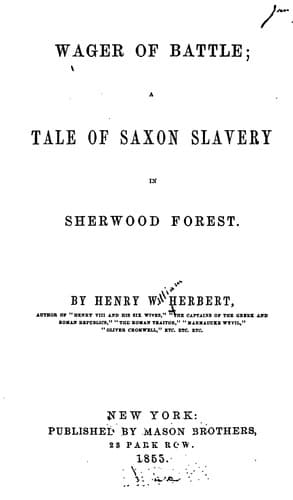
Wager of Battle: A Tale of Saxon Slavery in Sherwood ForestHerbert, Henry William
History
Wager of Battle: A Tale of Saxon Slavery in Sherwood Forest
Herbert, Henry William
Anglo-Saxons -- Fiction; Great Britain -- History -- Norman period, 1066-1154 -- Fiction; Sherwood Forest (England) -- Fiction
So long as Kenric and his mother remained in the hamlet of
Waltheofstow, and he was permitted to associate with them in their
quarter, in consequence of the character for patience, honesty,
fidelity, and good conduct, which his brother had acquired with his
masters, Eadwulf's temper had been in some sort restrained by the
influence, unconfessed indeed, and only half-endured with sullen
reluctance, which that brother obtained over him, through his clearer
and stronger intellect. But when they had departed, and when he found
himself ejected, as a single man in the first place, and yet more as
one marked for a bad servant and a dangerous character, from the best
cottage in the quarter, to which he had begun to fancy himself of
right entitled, he became worse and worse, until, even in the sort of
barrack or general lodging of the male slaves of the lowest order, he
was regarded by his fellows as the bad spirit of the set, and was
never sought by any, unless as the ringleader in some act of villainy,
wickedness, or rebellion.
It is probable, moreover, that the beauty and innocence of Edith, who,
however averse she might be to the temper and disposition of the man,
had been wont, since her betrothal to his brother, to treat him with a
certain friendship and familiarity, might have had some influence in
modifying his manner, at least, and curbing the natural display of his
passionate yet sullen disposition.
Certain it is, that in some sort he loved her--as much, perhaps, as
his sensual and unintelligent soul would allow him to love; and though
he never had shown any predilection, never had made any effort to
conciliate her favor, nor dared to attempt any rivalry of his brother,
whom he wholly feared, and half-hated for his assumed superiority, he
sorely felt her absence, regretted her liberation from slavery, and
even felt aggrieved at it, since he could not share her new condition.
His brother's freedom he resented as a positive injury done to
himself; and his bearing away with him the beautiful Edith, soon to
become his bride, he looked on in the light of a fraudulent or
forcible abstraction of his own property. From that moment, he became
utterly brutalized and bad; he was constantly ordered for punishment,
and at length he got to such a pitch of idleness, insolence, and
rebellion, that Sir Philip de Morville, though, in his reluctance to
resort to corporeal punishment, he would not allow him to be scourged
or set in the stocks, ordered his seneschal to take steps for selling
him to some merchant, who would undertake to transport him to one of
the English colonies in Ireland.
Circumstances, however, occurred, which changed the fate both of the
master and the slave, and led in the end to the events, which form the
most striking portion of the present narrative.
Public-domain text, read in full here on John Shaqi.
Reviews
Reviews
No reviews yet
Be the first to share your thoughts on this work.
Elsewhere in the archive
Join the Discussion
Join the discussion
Sign in to leave a comment or review.
Sign InorCreate an account