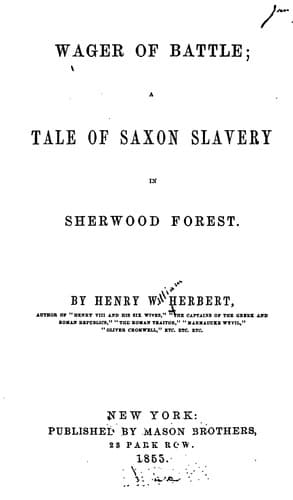
Wager of Battle: A Tale of Saxon Slavery in Sherwood Forest — John Shaqi
Wager of Battle: A Tale of Saxon Slavery in Sherwood ForestHerbert, Henry William
History
Wager of Battle: A Tale of Saxon Slavery in Sherwood Forest
Herbert, Henry William
Anglo-Saxons -- Fiction; Great Britain -- History -- Norman period, 1066-1154 -- Fiction; Sherwood Forest (England) -- Fiction
And if it were so, it was not unnatural; not at that day, alas!
uncommon; for dress, air, aspect, and demeanor, all told them at first
sight, to be of that most wretched, if not most abject class, the
Saxon serfs of England. They were both clad alike, in short, close-cut
frocks, or tunics, of tanned leather, gathered about their waists with
broad buff belts, fastened with brazen buckles, in each of which stuck
a long buckhorn-hafted two-edged Sheffield whittle; both were
bare-headed, both shod with heavy-clouted shoes, and both wore,
soldered about their necks, broad brazen dog-collars, having the brand
of their condition, with their own names and qualities, and that and
the condition of their master.
Here, however, ended the direct resemblance, even of their garb; for,
while the taller and better formed man of the two, who was also
somewhat the darker haired and finer featured, wore a species of rude
leather gauntlets, with buskins of the same material, reaching as high
as the binding of the frock, the other man was bare-armed and
bare-legged also, with the exception of an inartificial covering of
thongs of boar-hide, plaited from the ankle to the knee upward. The
latter also carried no weapon but a long quarter-staff, though he held
a brace of noble snow-white alans--the wire-haired grayhounds of the
day--in a leash of twisted buckskin; while his brother--for so strong
was their personal resemblance, that their kinship could scarcely be
doubted--carried a short, steel-headed javelin in his hand, and had
beside him, unrestrained, a large coarser hound, of a deep brindled
gray color, with clear, hazel eyes; and what was strange to say, in
view of the condition of this man, unmaimed, according to the cruel
forest code of the Norman kings.
This difference in the apparel, and, it may be added, in the neatness,
well-being, and general superior bearing of him who was the better
armed, might perhaps be explained by a glance at the engraving on the
respective collars. For while that of the one, and he the better clad
and better looking, bore that he was "Kenric the Dark, thral of the
land to Philip de Morville," that of the other stamped him "Eadwulf
the Red, gros thral" of the same Norman lord.
Both Saxon serfs of the mixed Northern race, which, largely intermixed
with Danish blood, produced a nobler, larger-limbed, loftier, and more
athletic race than the pure Saxons of the southern counties--they had
fallen, with the properties of the Saxon thane, to whom they had
belonged in common, into the hands of the foreign conqueror. Yet
Kenric was of that higher class--for there were classes even among
these miserable beings--which could not be sold, nor parted from the
soil on which they were born, but at their own option; while Eadwulf,
although his own twin-brother, for some cause into which it were
needless to inquire, could be sold at any time, or to any person, or
even swapped for an animal, or gambled away at the slightest caprice
of his owner.
Public-domain text, read in full here on John Shaqi.
Reviews
Reviews
No reviews yet
Be the first to share your thoughts on this work.
Join the Discussion
Join the discussion
Sign in to leave a comment or review.
Sign InorCreate an account