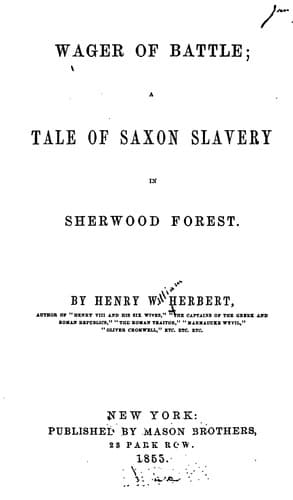
Wager of Battle: A Tale of Saxon Slavery in Sherwood Forest — John Shaqi
Wager of Battle: A Tale of Saxon Slavery in Sherwood ForestHerbert, Henry William
History
Wager of Battle: A Tale of Saxon Slavery in Sherwood Forest
Herbert, Henry William
Anglo-Saxons -- Fiction; Great Britain -- History -- Norman period, 1066-1154 -- Fiction; Sherwood Forest (England) -- Fiction
To this may be added, that, probably from caprice, or perhaps from
some predilection for his personal appearance and motions, which were
commanding, and even graceful, or for his bearing, which was evidently
less churlish than that of his countrymen in general, his master had
distinguished him in some respects from the other serfs of the soil;
and, without actually raising him to any of the higher offices
reserved to the Normans, among whom the very servitors claimed to be,
and indeed were, gentlemen, had employed him in subordinate stations
under his huntsman, and intrusted him so far as occasionally to permit
his carrying arms into the field.
With him, as probably is the case in most things, the action produced
reaction; and what had been the effect of causes, came in time to be
the cause of effects. Some real or supposed advantages procured for
him the exceeding small dignity of some poor half-conceded rights; and
those rights, the effect of perhaps an imaginary superiority, soon
became the causes of something more real--of a sentiment of half
independence, a desire of achieving perfect liberty.
In this it was that he excelled his brother; but we must not
anticipate. What were the characters of the men, and from their
characters what events grew, and what fates followed, it is for the
reader of these pages to decipher.
After our men had tarried where we found them, waiting till
expectation should grow into certainty for above half an hour, and the
morning had become clear and sunny, the distant indescribable sound,
heard indistinctly in the woods, ripened into that singularly
modulated, all sweet, but half-discordant crash, which the practiced
ear is not slow to recognize as the cry of a large pack of hounds,
running hard on a hot scent in high timber.
Anon the notes of individual hounds could be distinguished; now the
sharp, savage treble of some fleet brach, now the deep bass of some
southron talbot, rising above or falling far below the diapason of the
pack--and now, shrill and clear, the long, keen flourish of a Norman
bugle.
At the last signal, Kenric rose silently but quickly to his feet,
while his dog, though evidently excited by the approaching rally of
the chase, remained steady at his couchant position, expectant of his
master's words. The snow-white alans, on the contrary, fretted, and
strained, and whimpered, fighting against their leashes, while Eadwulf
sat still, stubborn or stupid, and animated by no ambition, by no
hope, perhaps scarce even by a fear.
Public-domain text, read in full here on John Shaqi.
Reviews
Reviews
No reviews yet
Be the first to share your thoughts on this work.
Join the Discussion
Join the discussion
Sign in to leave a comment or review.
Sign InorCreate an account