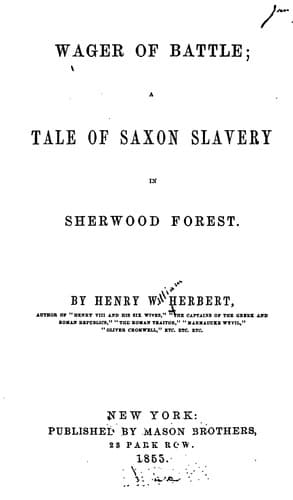
Wager of Battle: A Tale of Saxon Slavery in Sherwood ForestHerbert, Henry William
History
Wager of Battle: A Tale of Saxon Slavery in Sherwood Forest
Herbert, Henry William
Anglo-Saxons -- Fiction; Great Britain -- History -- Norman period, 1066-1154 -- Fiction; Sherwood Forest (England) -- Fiction
and perfect were the contentment and peace which the adjuncts inspired
into the hearts of those, who, of late so hopeless and suffering, now
looked over the face of the fair earth, and thence upward to the
boundless sky, as who should say, "Not in one only, but in both of
these, we have our heritage."
But while they gazed, the sun sunk lower in the west, the round tops
of the vast blue mountains intercepted his lustrous disk, and heavy
twilight fell, like the shadow of a cloud, over the valley and the
steep faces of the north-eastern hills.
Just at this moment, while the girl was whispering something about
entering the house and preparing the evening-meal, she observed her
husband's eye fixed on the declivity of the hills above the lake
shore, and, following the direction of his glance, she speedily
discovered a dark figure making its way in a crouching attitude among
the stunted shrubs, and evidently avoiding, or striving to avoid,
observation.
Something between a shudder and a start seemed to shake the manly form
of Kenric for an instant; and his young wife, perceiving it as she
clung to his arm, looked up to his face for explanation.
"Something is going wrong up yonder," said the verdurer; "some
marauder after the roe-deer, I trow. I must up and after him. Give me
my bugle, Edith, my wood-knife, and my gisarme; I will take the black
alan with me; he lies under the settle, by the hearth. Fetch them,
girl."
And while she went, he stood gazing with his hawk's eye on the lurking
figure, though it was wonderful, in the distance and gloom, that he
could distinguish even the outlines of the human form. Yet it was
evident that he did distinguish something more than that, for he smote
his thigh with his hand heavily, as he muttered, "It is he, by St.
Edward the Confessor! What new disaster can have brought him hither?"
The next moment Edith stood beside him, bearing the weapons, and
accompanied by the great grizzly deer-grayhound.
"Kenric," she said, as he was leaving her, "this is something more
than mere marauders. There is danger!"
"I trust not, girl," he answered, kindly; "but if there be, I and
Black Balder here, are men enough to brunt it. But hark you, girl, get
supper over as quickly as you may, and have our mother to her chamber,
and the varlets to their quarter in the kennels; and do you sit up,
without a light, mark me, and, whatever shall fall out, be silent. I
may bring some one with me."
"I knew it," she murmured to herself, as she turned away to do his
bidding. "It is Eadwulf. What brings him hither? No good, I warrant
me."
Meanwhile Kenric scaled the crags rapidly, with the hound at his
heels, and, when he reached the spot where he had seen the figure,
halted, and whistled a bar or two of an old Saxon ballad of Sherwood.
It was answered, and from out of the brushwood Eadwulf came, cringing,
travel-soiled, weary, and disaster-stricken, to the knees almost of
his brother.
Public-domain text, read in full here on John Shaqi.
Reviews
Reviews
No reviews yet
Be the first to share your thoughts on this work.
Elsewhere in the archive
Join the Discussion
Join the discussion
Sign in to leave a comment or review.
Sign InorCreate an account