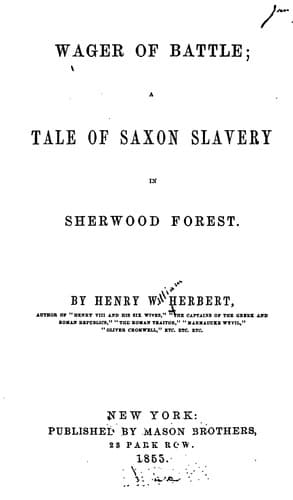
Wager of Battle: A Tale of Saxon Slavery in Sherwood ForestHerbert, Henry William
History
Wager of Battle: A Tale of Saxon Slavery in Sherwood Forest
Herbert, Henry William
Anglo-Saxons -- Fiction; Great Britain -- History -- Norman period, 1066-1154 -- Fiction; Sherwood Forest (England) -- Fiction
"So. This is thou, Eadwulf? I thought as much. What brings thee
hither?"
"Almost as fair cause as I find fair welcome."
"I looked for no other. Thou art a runaway, then, and pursued? Come,
speak out, man, if thou wouldst have me aid thee."
"Thou dost not seem overly glad to see me, brother."
"How should I be glad? When did thy presence ever bring joy, or aught
else than disaster and disgrace? But speak, what brings thee hither?
How hast thou escaped? Art thou pursued? What dost thou require?"
"Last asked, first answered. Rest, refuge, clothing, food, asylum.
Last Monday is a week, I _was_ pursued; pursuit has ceased, but I
misdoubt me I am tracked. By strong hand I escaped, and fleet foot----"
"By red hand?" asked Kenric.
"Ay! red, with the blood of deer!"
"And of man, Eadwulf? Nay! man, lie not to me. Dark as it is, I read
it in thy black brow and sullen eye."
"Well, then, man's blood, if you will. And now, will you yield your
own brother's life a forfeit to the man-hunter, or the hunter of
blood?"
"No," answered Kenric, sadly; "that must not be. For you _are_ my
brother. But I must know _all_, or I will do nothing. You can tell
me as we go; my home is in the valley yonder. There you can rest
to-night; to-morrow you must away to the wilderness, there to be safe,
if you may, without bringing ruin upon those who, doing all for you,
look for nothing from you but wrong and ingratitude."
"To-morrow! True brotherly affection! Right Saxon hospitality. Our
fathers would have called this _nidering_!"
"Never heed thou that. Tell me all that has passed, or thou goest not
to my house, even for this night only. For myself, I care nothing, and
fear nothing. My wife, and my mother--these, thy blind selfishness and
brute instincts, at least, shall not ruin."
And thereupon, finding farther evasion useless, as they went homeward
by a circuitous path among the rocks and dingles, he revealed all that
the reader knows already, and this farther, which it is probable he
has suspected, that Eadwulf, lying concealed in the forest in
pursuance of some petty depredation, had been a witness of the
dastardly murder of Sir Philip de Morville by the hands of Sir Foulke
d'Oilly and his train, among whom most active was the black seneschal,
who had perished so fearfully in the quicksands.
Public-domain text, read in full here on John Shaqi.
Reviews
Reviews
No reviews yet
Be the first to share your thoughts on this work.
Elsewhere in the archive
Join the Discussion
Join the discussion
Sign in to leave a comment or review.
Sign InorCreate an account