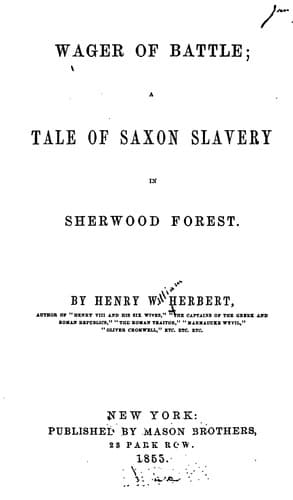
Wager of Battle: A Tale of Saxon Slavery in Sherwood ForestHerbert, Henry William
History
Wager of Battle: A Tale of Saxon Slavery in Sherwood Forest
Herbert, Henry William
Anglo-Saxons -- Fiction; Great Britain -- History -- Norman period, 1066-1154 -- Fiction; Sherwood Forest (England) -- Fiction
But the same blow which unhelmed d'Oilly disarmed Aradas. His faithless
sword was shivered to the hilt; and what should he do now, with only
that weak, short estoc, that cumbrous dagger, against the downright
force of the resistless double-handed glaive?
Backward he sprang ten paces. The glittering estoc was in his right,
the short massive dagger in his left. He dropped on his right knee,
crouching low, both arms hanging loosely by his sides, but with his eye
glaring on his foeman, like that of the hunted tiger.
No sooner had Sir Foulke rallied from the stunning effects of the blow,
and seen how it was with him, his enemy disarmed, and, as it seemed, at
his power, than a hideous sardonic smile glared over his lurid
features, and he strode forward with his sword aloft, to triumph and to
kill. When he was within six paces of his kneeling adversary, he
paused, measured his distance--it was the precise length for one
stride, one downright blow, on that bare head, which no earthly power
could now shield against it.
There was no cry now among the people--only a hush. Every heart stood
still in that vast concourse.
"Wilt die, or cry 'craven?'"
The eye of Aradas flashed lightning. Lower, he crouched lower, to the
ground. His left hand rose slowly, till the guard of his dagger was
between his own left, and his enemy's right eye. His right hand was
drawn so far back, that the glittering point of the estoc only showed
in front of his hip. Lower, yet lower, he crouched, almost in the
attitude of the panther couchant for his spring.
One stride made Sir Foulke d'Oilly forward; and down, like some
tremendous engine, came the sword-sweep--the gazers heard it whistle
through the air as it descended.
What followed, no eye could trace, no pen could describe. There was a
wild cry, like that of a savage animal; a fiery leap through a cloud of
whirling dust; a straight flash through the haze, like lightning.
One could see that somehow or other that slashing cut was glanced
aside, but how, the speed of thought could not trace.
It was done in a second, in the twinkling of an eye. And, as the dust
subsided, there stood Aradas, unmoved and calm as the angel of death,
with his arms folded, and nothing in his hand save the dagger shivered
to the guard. And at his feet lay his enemy, as if stricken by a
thunderbolt, with his eyes wide open and his face to heaven, and the
deadly estoc buried, to the gripe, in the throat, that should lie no
more forever.
Pass we the victor's triumph, and the dead traitor's doom; pass we the
lovers' meeting, and the empty roar of popular applause. That was,
indeed, the judgment of God; and when God hath spoken, in the glory of
his speechless workings, it is good that man should hold his peace
before him.
CHAPTER XXVII.
THE BRIDAL DAY.
"The roads should blossom, the roads should bloom,
So fair a bride shall leave her home!
Should blossom and bloom with garlands gay,
So fair a bride shall pass to-day."
Public-domain text, read in full here on John Shaqi.
Reviews
Reviews
No reviews yet
Be the first to share your thoughts on this work.
Elsewhere in the archive
Join the Discussion
Join the discussion
Sign in to leave a comment or review.
Sign InorCreate an account