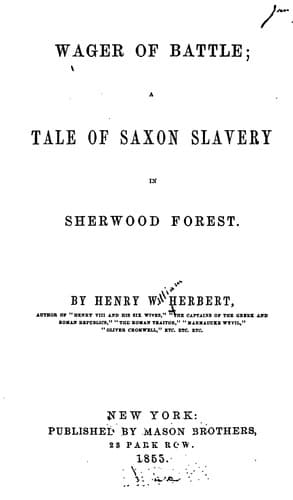
Wager of Battle: A Tale of Saxon Slavery in Sherwood Forest — John Shaqi
Wager of Battle: A Tale of Saxon Slavery in Sherwood ForestHerbert, Henry William
History
Wager of Battle: A Tale of Saxon Slavery in Sherwood Forest
Herbert, Henry William
Anglo-Saxons -- Fiction; Great Britain -- History -- Norman period, 1066-1154 -- Fiction; Sherwood Forest (England) -- Fiction
It was a fearful sight that met the eyes of the first comer. He was
the Norman who had ridden second in the chase, but now, having
outstripped his friendly rival in the neck-or-nothing skurry that
succeeded, thundered the first into the road, where the dogs were now
mangling the slaughtered stag, and besmearing the pale face of the
senseless girl with blood and bestial foam.
To spring from his saddle and drop on his knees beside her, was but a
moment's work.
"My child! my child! they have slaughtered thee. Woe! woe!"
CHAPTER III.
THE GUERDON OF GOOD SERVICE.
"'Twere better to die free, than live a slave."
EURIPIDES.
It was fortunate, for all concerned, that no long time elapsed before
more efficient aid came on the ground, than the gentleman who first
reached the spot, and who, although a member of that dauntless
chivalry, trained from their cradles to endure hardship, to despise
danger, and to look death steadfastly and unmoved in the face, was so
utterly paralyzed by what he deemed, not unnaturally, the death of his
darling, that he made no effort to relieve her from the weight of the
slaughtered animal, though it rested partially on her lower limbs, and
on one arm, which lay extended, nevertheless, as it had fallen, in the
dust. But up came, in an instant, Philip de Morville, on his superb,
snow-white Andalusian, a Norman baron to the life--tall, powerful,
thin-flanked, deep-chested, with the high aquiline features and dark
chestnut hair of his race, nor less with its dauntless valor, grave
courtesy, and heart as impassive to fear or tenderness or pity, as his
own steel hauberk. Up came esquires and pages, foresters and grooms,
and springing tumultuously to the ground, under the short, prompt
orders of their lord, raised the dead palfrey bodily up, while Sir
Philip drew the fair girl gently from under it, and raising her in his
arms more tenderly than he had ever been known to entreat any thing,
unless it were his favorite falcon, laid her on the short, soft
greensward, under the shadow of one of the huge, broad-headed oaks by
the wayside.
Public-domain text, read in full here on John Shaqi.
Reviews
Reviews
No reviews yet
Be the first to share your thoughts on this work.
Join the Discussion
Join the discussion
Sign in to leave a comment or review.
Sign InorCreate an account