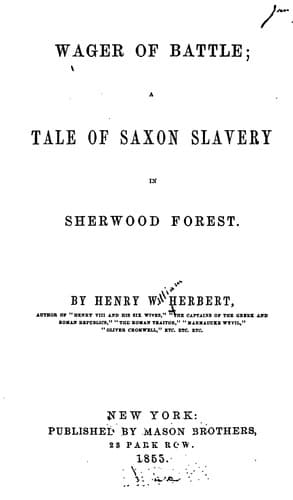
Wager of Battle: A Tale of Saxon Slavery in Sherwood ForestHerbert, Henry William
History
Wager of Battle: A Tale of Saxon Slavery in Sherwood Forest
Herbert, Henry William
Anglo-Saxons -- Fiction; Great Britain -- History -- Norman period, 1066-1154 -- Fiction; Sherwood Forest (England) -- Fiction
"Cheer thee, my noble lord and brother," he exclaimed, "the Lady
Guendolen is not dead, nor like to die this time. 'Tis only fear, and
perchance her fall, for it was a heavy one, that hath made her faint.
Bustle, knaves, bustle. Bring water from the spring yonder. Has no one
a leathern bottiau? You, Damian, gallop, as if you would win your
spurs of gold by riding, to the sumpter mule with the panniers. It
should be at the palmer's spring by this time; for, hark, the bells
from the gray brothers' chapel, in the valley by the river, are
chiming for the noontide service. Bring wine and essences, electuaries
and ambergris, if the refectioner have any with him. You, Raoul," he
continued, addressing a sturdy, grim-featured old verdurer, who was
hanging over the still senseless girl with an expression of solicitude
hardly natural to his rugged and scar-seamed countenance, "take a led
horse, and hie thee to the abbey; tell the good prior what hath
befallen, and pray the brother mediciner he will ride this way, as
speedily as he may; and you," turning to the old, white-haired
seneschal, "send up some of the varlets to the castle, for the
horse-litter; she may not ride home this day."
In the mean time, while he was accumulating order on order, while
pages and horse-boys, grooms and esquires, were galloping off, in
different directions, as if with spurs of fire, and while the barons
themselves were awkwardly endeavoring to perform those ministrations
for the fair young creature, which they were much more used themselves
to receive at the hands of the softer sex, who were in those rude days
often the chirurgeons and leeches, as well as the comforters and
soothers of the bed of pain and sickness, than to do such offices for
others, the bold defender of Guendolen--Kenric the dark-haired--lay in
his blood, stark and cold, deemed dead, and quite forgotten, even by
the lowest of the Norman varletry, who held themselves too noble to
waste services upon a Saxon, much more upon a thral and bondsman.
They--such of them, that is to say, as were not needed in direct
attendance on the persons of the nobles, or as had not been dispatched
in search of aid--applied themselves, with characteristic zeal and
eagerness, to tend and succor the nobler animals, as they held them,
of the chase; while they abandoned their brother man and
fellow-countryman, military Levites as they were, to his chances of
life or death, without so much as even caring to ask or examine
whether he were numbered with the living or the dead.
The palfrey was first seen to, and pronounced dead; when his rich
housings were stripped off carefully, and cleaned as well as time and
place permitted; when the carcass was dragged off the road, and
concealed, for the moment, with fern leaves and boughs lopped from the
neighboring bushes, while something was said among the stable boys of
sending out some of the "dog Saxon serfs" to bury him on the morrow.
Public-domain text, read in full here on John Shaqi.
Reviews
Reviews
No reviews yet
Be the first to share your thoughts on this work.
Join the Discussion
Join the discussion
Sign in to leave a comment or review.
Sign InorCreate an account