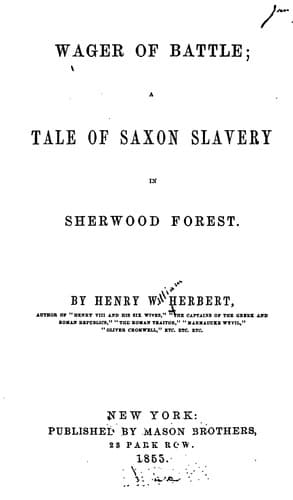
Wager of Battle: A Tale of Saxon Slavery in Sherwood Forest — John Shaqi
Wager of Battle: A Tale of Saxon Slavery in Sherwood ForestHerbert, Henry William
History
Wager of Battle: A Tale of Saxon Slavery in Sherwood Forest
Herbert, Henry William
Anglo-Saxons -- Fiction; Great Britain -- History -- Norman period, 1066-1154 -- Fiction; Sherwood Forest (England) -- Fiction
"Dear father," she whispered, faintly; but, the next moment, an
expression of fear was visible in all her features, and a palpable
shiver shook all her frame. "The stag!" she murmured; "the stag! save
me, save"--and before the word, uttered simultaneously by the two
lords--"He is dead, dear one," "He will harm no one any more"--had
reached her ears, she again relapsed into insensibility, while with
equal care, but renewed hope, they tended and caressed her.
But Kenric no one tended, no one caressed, save, "faithful still,
where all were faithless found," the brindled staghound, "Kilbuck,"
who licked his face assiduously, with his grim, gory tongue and lips,
and besmearing his face with blood and foam, rendered his aspect yet
more terrible and death-like.
But now the returning messengers began to ride in, fast and frequent;
first, old Raoul, the huntsman, surest, although not fleetest, and
with him, shaking in his saddle, between the sense of peril and the
perplexity occasioned him by the high, hard trot of the Norman
war-horse pressed into such unwonted service, "like a boar's head in
aspick jelly," the brother mediciner from the neighboring convent,
with his wallet of simples and instruments of chirurgery.
By his advice, the plentiful application of cold water, with essences
and stimulants in abundance, a generous draught of rich wine of
Burgundy, and, when animation seemed thoroughly revived, the gentle
breathing of a vein, soon restored the young lady to her perfect
senses and complete self-possession, though she was sorely bruised,
and so severely shaken that it was enjoined on her to remain perfectly
quiet, where she lay, with a Lincoln-green furred hunting-cloak around
her, until the arrival of the litter should furnish means of return to
the castle of her father's host and kinsman.
And, in good season, down the hill, slowly and toilsomely came the
horse-litter, poor substitute for a wheeled vehicle; but even thus the
best, if not only, conveyance yet adopted for the transport of the
wounded, the feeble, or the luxurious, and, as such, used only by the
wealthy and the noble.
With the litter came three or four women; one or two, Norman maidens,
the immediate attendants of the Lady Guendolen, and the others, Saxon
slave girls of the household of Sir Philip de Morville, who hurried
down, eager to gain favor by show of zealous duty, or actuated by
woman's feelings for woman's suffering, even in different grades and
station.
The foremost of them all, bounding along with all the wild agility and
free natural gracefulness of wood-nymph or bacchante, was a girl of
seventeen or eighteen, not above the middle height of her sex, but
plump as a partridge, with limbs exquisitely formed and rounded, a
profusion of flaxen tresses floating unrestrained on the air, large
dark-blue eyes, and a complexion all of milk and roses--the very type
of rural Saxon youth and beauty.
Public-domain text, read in full here on John Shaqi.
Reviews
Reviews
No reviews yet
Be the first to share your thoughts on this work.
Join the Discussion
Join the discussion
Sign in to leave a comment or review.
Sign InorCreate an account