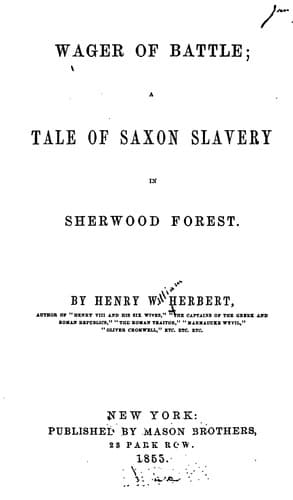
Wager of Battle: A Tale of Saxon Slavery in Sherwood ForestHerbert, Henry William
History
Wager of Battle: A Tale of Saxon Slavery in Sherwood Forest
Herbert, Henry William
Anglo-Saxons -- Fiction; Great Britain -- History -- Norman period, 1066-1154 -- Fiction; Sherwood Forest (England) -- Fiction
As she outstripped all the rest in speed, she was the first to tender
gentle service to the Lady Guendolen, who received her with a smile,
calling her "Edith the Fair," and thanking her for her ready aid.
But, ere long, as the courtlier maidens arrived on the ground, poor
Edith was set aside, as is too often the case with humble merit, while
the others lifted the lady into the horse-litter, covered her with
light and perfumed garlands, and soon had all ready for her departure.
But, in the mean time, Edith had turned a hasty glance around her; and
descrying the inanimate body of the Saxon serf, lying alone and
untended, moved by the gentle sympathy of woman for the humblest
unknown sufferer, she hastened to assist, if assistance were still
possible. But, as she recognized the limbs, stately, though cold and
still, and the features, still noble through gore and defilement, a
swift horror smote her, that she shook like a leaf, and fell, with a
wild, thrilling shriek, "O, Kenric, Kenric!" on the body of the
wounded man.
"Ha! what is this?" cried Sir Philip, who now first saw or remembered
what had passed. "How is this? Knaves, is there a man hurt here?"
"A Saxon churl, Beausire," replied one of the pages, flippantly, "who
has gotten his brisket unseamed by his brother Saxon yonder!" and he
pointed to the dead carcass of the stag.
"Our lady save us," murmured the gentle Guendolen, who seemed about to
relapse into insensibility; "he saved my life, and have ye let him
perish?"
"Now, by the splendor of our lady's eyes!" cried Yvo de Taillebois,
the father of the fair young lady, "this is the gallant lad we saw
afar, in such bold hand-to-hand encounter with yon mad brute. We have
been ingrately, shamefully remiss. This must be amended, Philip de
Morville."
"It shall, it shall, my noble friend," cried Philip; "and ye, dogs,
that have let the man perish untended thus, for doing of his devoir
better than all the best of ye, bestir yourselves. If the man die, as
it seems like enow, ye shall learn ere ye are one day older, what
pleasant bed-rooms are the vaults of Waltheofstow, and how tastes the
water of the moat."
Meantime the monk trotted up, and, after brief examination, announced
that, though badly hurt, his life was in no immediate peril, and set
himself at once to comfort and revive him.
"He is not slain; he will not die, my child," said Sir Yvo, softly,
bending over the litter to his pale lily, who smiled faintly as she
whispered in reply--
"Dear father, nor be a slave any longer?"
"Not if I may redeem him," he answered; "but I will speak with Sir
Philip at once. Meanwhile be tranquil, and let them convey you
homeward. Forward, there, with the litter--gently, forward!"
And, therewith, he turned and spoke eagerly to De Morville, who
listened with a grave brow, and answered;
"If it may be, my noble friend and brother. If it may be. But there
are difficulties. Natheless, on my life, I desire to pleasure you."
Public-domain text, read in full here on John Shaqi.
Reviews
Reviews
No reviews yet
Be the first to share your thoughts on this work.
Join the Discussion
Join the discussion
Sign in to leave a comment or review.
Sign InorCreate an account