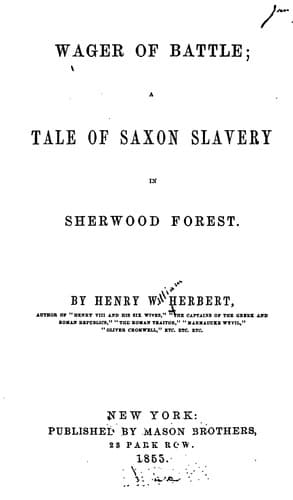
Wager of Battle: A Tale of Saxon Slavery in Sherwood ForestHerbert, Henry William
History
Wager of Battle: A Tale of Saxon Slavery in Sherwood Forest
Herbert, Henry William
Anglo-Saxons -- Fiction; Great Britain -- History -- Norman period, 1066-1154 -- Fiction; Sherwood Forest (England) -- Fiction
This keep, with the exception of the tall battlemented flanking walls,
with their esplanades and turrets, and advanced barbican or
gate-house, was the only genuine Norman portion of the castle, and
occupied the very summit of the knoll; but below it, and for the most
part concealed and covered by the ramparts on which it abutted, was a
long, low, roomy stone building, which had been in old times the
mansion of the Saxon thane, who had occupied the rich and fertile
lands of that upland vale, in the happy days before the advent of the
fierce and daring Normans, to whom he had lost both life and lands,
and left an empty name alone to the inheritance, which was not to
descend to any of his race or lineage.
Below the walls, which encircled the hillock about midway between the
base and summit, except at one spot, where the gate-house was thrust
forward to the brink of a large and rapid brook, which had been made
by artificial means completely to encircle the little hill, the slopes
were entirely bare of trees or underwood, every thing that could
possibly cover the advances of an enemy being carefully cut down or
uprooted, and were clothed only by a dense carpet of short, thick
greensward, broidered with daisies pied, and silver lady's smocks; but
beyond the rivulet, covering all the bottom of the valley with rich
and verdant shade, were pleasant orchards and coppices, among which
peeped out the thatched roofs and mud walls of the little village,
inhabited by the few free laborers, and the more numerous thralls and
land-serfs, who cultivated the demesnes of the foreign noble, who
possessed them by right of the sword.
Through this pleasant little hamlet, the yellow road, which led up to
the castle, wound devious, passing in its course by an open green, on
which half a dozen sheep and two or three asses were feeding on the
short herbage, with a small Saxon chapel, distinguished by its low,
round, wolf-toothed arch and belfry, on the farther side; and, in
singular proximity to the sacred edifice, a small space, inclosed by a
palisade, containing a gallows, a whipping-post, and a pair of
stocks--sad monuments of Saxon slavery, and Norman tyranny and wrong.
In one of the upper chambers of the feudal keep, a small square room,
with a vaulted roof, springing from four clustered columns in the
corners, with four groined ribs, meeting in the middle, from which
descended a long, curiously-carved pendant of stone, terminating in a
gilt iron candelabrum of several branches, two men were seated at a
board, on which, though the solid viands of the mid-day meal had been
removed, there were displayed several silver dishes, with wastel
bread, dried fruits, and light confections, as well as two or three
tall, graceful flasks of the light fragrant wines of Gascony and
Anjou, and several cups and tankards of richly-chased and gilded
metal, intermixed with several large-bowled and thin-stemmed goblets
of purple and ruby-colored glass.
Public-domain text, read in full here on John Shaqi.
Reviews
Reviews
No reviews yet
Be the first to share your thoughts on this work.
Join the Discussion
Join the discussion
Sign in to leave a comment or review.
Sign InorCreate an account