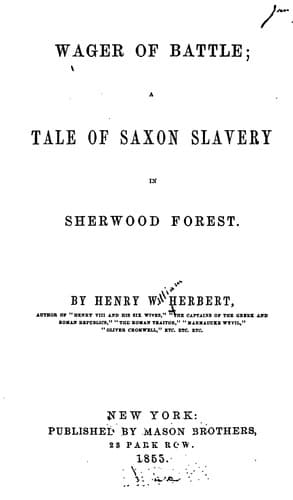
Wager of Battle: A Tale of Saxon Slavery in Sherwood ForestHerbert, Henry William
History
Wager of Battle: A Tale of Saxon Slavery in Sherwood Forest
Herbert, Henry William
Anglo-Saxons -- Fiction; Great Britain -- History -- Norman period, 1066-1154 -- Fiction; Sherwood Forest (England) -- Fiction
The room was a very pleasant one, lighted by two tall windows, on two
different sides, which stood wide open, admitting the soft, balmy,
summer air, and the fresh smell of the neighboring greenwoods, the
breezy voice of which came gently in, whispering through the casement.
The walls were hung with tapestries of embossed and gilded Spanish
leather, adorned with spirited figures of Arab skirmishers and
Christian chivalry, engaged in the stirring game of warfare; while, no
unfit decoration for a wall so covered, two or three fine suits of
chain and plate armor, burnished so brightly that they shone like
silver, with their emblazoned shields and appropriate weapons, stood,
like armed knights on constant duty, in canopied niches, framed
especially to receive them.
Varlets, pages, and attendants, had all withdrawn; and the two Norman
barons sat alone, sipping their wine in silence, and apparently
reflecting on some subject which they found it difficult to approach
without offense or embarrassment. At last, the younger of the two, Sir
Philip de Morville, after drawing his open hand across his fair, broad
forehead, as if he would have swept away some cloud which gloomed over
his mind, and drinking off a deep goblet of wine, opened the
conversation with evident confusion and reluctance.
"Well, well," he said, "it must out, Sir Yvo, and though it is not
very grateful to speak of such things, I must needs do so, lest I
appear to you uncourtly and ungracious, in hesitating to do to you,
mine own most tried and trusty friend, to whom I owe no less than my
own life, so small a favor as the granting liberty to one poor devil
of a Saxon. I told you I would do it, if I might; yet, by my father's
soul, I know not how to do it!"
"Where is the rub, my friend?" replied the other, kindly. "I doubt
not, if we put both our heads together, we can accomplish even a
greater thing than making a free English yeoman of a Saxon thrall."
"I never was rich, as you well know, De Taillebois; but at the time of
the king's late incursion into Wales, when I was summoned to lead out
my power, I had no choice but to mortgage this my fortalice, with its
demesne of Waltheofstow, and all its plenishing and stock, castle and
thralls, and crops and fisheries, to Abraham of Tadcaster, for
nineteen thousand zecchins, to buy their outfitting, horses, and
armor; and this prohibits me from manumitting this man, Kenric,
although I would do so right willingly, not for that it would pleasure
you only, but that he is a faithful and an honest fellow for a thrall,
and right handy, both with arbalast and longbow. I know not well how
to accomplish it."
Public-domain text, read in full here on John Shaqi.
Reviews
Reviews
No reviews yet
Be the first to share your thoughts on this work.
Join the Discussion
Join the discussion
Sign in to leave a comment or review.
Sign InorCreate an account