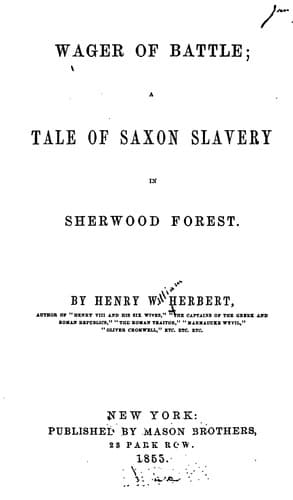
Wager of Battle: A Tale of Saxon Slavery in Sherwood Forest — John Shaqi
Wager of Battle: A Tale of Saxon Slavery in Sherwood ForestHerbert, Henry William
History
Wager of Battle: A Tale of Saxon Slavery in Sherwood Forest
Herbert, Henry William
Anglo-Saxons -- Fiction; Great Britain -- History -- Norman period, 1066-1154 -- Fiction; Sherwood Forest (England) -- Fiction
"Refused to go--to be free--to be his own master, and a thrall and
slave no longer!"
"Who can tell, sir?" answered the man. "Saxon or Norman, bond or free,
we're all men, after all; and women have made fools of us all, since
the days of Sir Adam in Paradise, and will, I fancy, to the end of all
time. I'd do and suffer a good deal myself to win such a look out of
Edith's blue eyes, as I saw her give yon Saxon churl, when he came to
after we had thrown cold water on him. And, after all, if Sir
Hercules, of Greece, made a slave of himself, and a she-slave, too, as
that wandering minstrel sang to us in the hall the other day, all to
win the love of the beautiful Sultana, Omphale, I don't see, for
myself, why a Saxon serf, that's been a serf all his life, and got
pretty well used to it by this time, shouldn't stay a serf all the
rest of it, to keep the love of Edith, who is prettier a precious
sight than the fair Turk, Omphale, I'll warrant. I don't know but what
I would myself."
"Pshaw! Stephen; that smacks Norman--smacks of the _gai science_,
chivalry, sentiment, and fine high romance. You'll never see a Saxon
sing 'all for love,' I'll warrant you."
"Well, sir, well. We shall see. A Saxon's a man, as I said before; and
a Saxon in love is a man in love; and a man in love isn't a man in his
senses any more than Sir Hercules of Greece was, and when a Saxon's in
love, and out of his senses, there's no saying what he'll do; only one
may guess it will be nothing over wise. And so, as I said before, I
should not wonder if Kenric should not part with collar, thong, and
shackles, if he must needs part too with little Edith the Fair. I
would not, any wise, if I were he, Beausire."
CHAPTER V.
THE SERF'S QUARTER.
"As they sat in Englyshe wood,
Under the greenwode tree,
They thought they heard a woman wepe,
But her they mought not see."
ADAM BELL, ETC.
Leaving the warder lounging listlessly at his post, as in a
well-settled district and in "piping times of peace," with no feudal
enemies at hand, and no outlaws in the vicinity, none at least so
numerous as to render any guard necessary, except as a matter of
dignity and decorum, the two knights strolled down the sandy lane
toward the village, or quarter of the serfs; who were not admitted
generally to reside within the walls, partly as a precaution, lest, in
case of some national affray, they might so far outnumber the Norman
men-at-arms as to become dangerous, partly because they were not
deemed fitting associates for the meanest of the feudal servitors.
Public-domain text, read in full here on John Shaqi.
Reviews
Reviews
No reviews yet
Be the first to share your thoughts on this work.
Join the Discussion
Join the discussion
Sign in to leave a comment or review.
Sign InorCreate an account