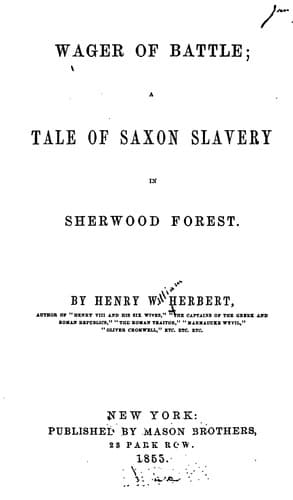
Wager of Battle: A Tale of Saxon Slavery in Sherwood Forest — John Shaqi
Wager of Battle: A Tale of Saxon Slavery in Sherwood ForestHerbert, Henry William
History
Wager of Battle: A Tale of Saxon Slavery in Sherwood Forest
Herbert, Henry William
Anglo-Saxons -- Fiction; Great Britain -- History -- Norman period, 1066-1154 -- Fiction; Sherwood Forest (England) -- Fiction
The two gentlemen in question were excellent specimens of the Norman
baron of the day, without, however, being heroes or geniuses, or in
any particular--except perhaps for good temper and the lack of
especial temptation toward evil--manifestly superior to others of
their class, caste, and period. Neither of them was in any respect a
tyrant, individually cruel, or intentionally an oppressor; but both
were, as every one of us is at this day, used to look at things as we
find them, through our own glasses, and to seek rather for what is the
custom, than for what is right, and therefore ought to be; for what it
suits us, and is permitted to us by law to do to others, than for what
we should desire others to do unto us.
Reckless of life themselves, brought up from their cradles to regard
pain as a thing below consideration, and death as a thing to be risked
daily, they were not like to pay much regard to the mere physical
sufferings of others, or to set human life at a value, such as to
render it worth the preserving, when great stakes were to be won or
lost on its hazard. Accustomed to set their own lives on the die, for
the most fantastic whim of honor, or at the first call of their feudal
suzerains, accustomed to see their Norman vassals fall under shield,
and deem such death honorable and joyous, at their own slightest
bidding, how should they have thought much of the life, far more of
the physical or mental sufferings, of the Saxon serf, whom they had
found, on their arrival in their newly-conquered England, a thing
debased below the value, in current coin, of an ox, a dog, or a
war-horse--a thing, the taking of whose life was compensated by a
trivial fine, and whom they naturally came to regard as a dull,
soulless, inanimate, stupid senseless animal, with the passions only,
but without the intellect of the man. Of the two barons, Sir Yvo de
Taillebois was the superior, both in intellect and culture; he was in
easy circumstances also, while his far younger friend, Sir Philip de
Morville, was embarrassed by the _res angusta domi_, and by the
importunity of relentless creditors, which often drives men to do, as
well as to suffer, extremes.
Public-domain text, read in full here on John Shaqi.
Reviews
Reviews
No reviews yet
Be the first to share your thoughts on this work.
Join the Discussion
Join the discussion
Sign in to leave a comment or review.
Sign InorCreate an account