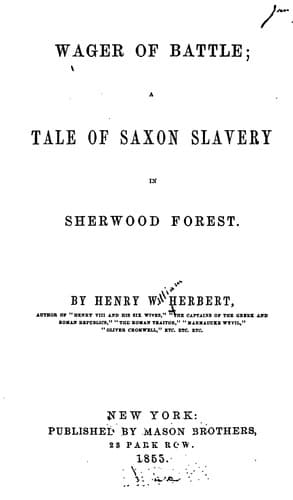
Wager of Battle: A Tale of Saxon Slavery in Sherwood ForestHerbert, Henry William
History
Wager of Battle: A Tale of Saxon Slavery in Sherwood Forest
Herbert, Henry William
Anglo-Saxons -- Fiction; Great Britain -- History -- Norman period, 1066-1154 -- Fiction; Sherwood Forest (England) -- Fiction
In addition, however, to their grim and sordid aspect, and their
evident ignorance, or carelessness, of their base appearance, there
was a dull, sullen, dogged expression on all their faces--a look not
despairing, nor even sorrowful, but perfectly impassive, as if they
had nothing to hope for, or regret, or fear; the look of a caged bear,
wearied and fattened out of his fierceness, not tamed, civilized, or
controlled by any human teaching.
The stature and bearing, even of the freeborn and noble Saxon, in the
day when his fair isle of Albion was his own, and he trod the soil its
proud proprietor, had never been remarkable for its beauty, grace, or
dignity. He was, for the most part, short, thick-set, sturdy-limbed,
bull-necked, bullet-headed; a man framed more for hardihood,
endurance, obstinate resolve, indomitable patience to resist, than for
vivid energy, brilliant impulsive vigor, or ardor, whether
intellectual or physical; but these men, though they neither lounged
nor lagged behind, plodded along with a heavy, listless gait, their
frowning brows turned earthward, their dull gray eyes rolling beneath
their light lashes, meaningless and spiritless, and the same scowl on
every gloomy face.
The younger women, a few of whom were seen about the doors or gardens,
busied in churning butter, making cheese, or performing other duties
of the farm and dairy, were somewhat more neatly, and, in some few
cases, even tastefully attired. Some were of rare beauty, with a
profusion of auburn, light brown, or flaxen hair, bright rosy
complexions, large blue eyes, and voluptuous figures; and these bore
certainly a more cheerful aspect, as the nature of woman is more
hopeful than that of man, and a more gentle mood than their fellows;
yet there were no songs enlivening their moments of rest or
alleviating their hours of toil--no jests, no romping, as we are wont
to see among young girls of tender years, occupied in the lighter and
more feminine occupations of agricultural life.
Some one or two of these, indeed, smiled as they courtesied to their
lord, but the smile was wan and somewhat sickly, nor seemed to come
from the heart; it gave no pleasure, one would say, to her who
gave--no pleasure to him who received it.
The little children, however, who tumbled about in the dust, or built
mud-houses by the puddles in the road, were the saddest sight of all.
Half-naked, sturdy-limbed, filthy little savages, utterly untaught and
untamed, scarcely capable of making themselves understood, even in
their own rude dialect; wild-eyed, and fierce or sullen-looking as it
might, subject to no control or correction, receiving no education, no
culture whatsoever--not so much even as the colt, which is broken at
least to the menage, or the hound-puppy, which is entered at the
quarry which he is to chase; ignorant of every moral or divine
truth--ignorant even that each one of them was the possessor of a
mortal body, far more of an immortal soul!
Public-domain text, read in full here on John Shaqi.
Reviews
Reviews
No reviews yet
Be the first to share your thoughts on this work.
Join the Discussion
Join the discussion
Sign in to leave a comment or review.
Sign InorCreate an account