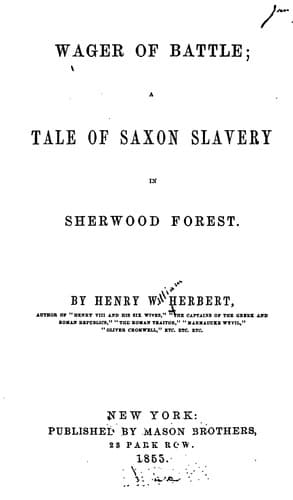
Wager of Battle: A Tale of Saxon Slavery in Sherwood ForestHerbert, Henry William
History
Wager of Battle: A Tale of Saxon Slavery in Sherwood Forest
Herbert, Henry William
Anglo-Saxons -- Fiction; Great Britain -- History -- Norman period, 1066-1154 -- Fiction; Sherwood Forest (England) -- Fiction
All the huts, therefore, rudely framed of oak beams, having the
interstices filled in with a cement of clay and ruddle, with thatched
roofs and wooden lattices instead of windows, were whole, and for the
most part weather-proof. Many of the inhabitants had made porches,
covered with natural wild runners, as the woodbine and sweet-brier;
all had made gardens in front, which they might cultivate in their
hours of leisure, when the day's task-work should be done, and which
displayed evidently enough, by their orderly or slovenly culture, the
character and disposition of their occupants.
The few men whom the lords met on their way, mostly driving up beasts
laden with fire-wood or forage to the cattle, for the day was not yet
far spent, nor the hours devoted to toil well-nigh passed, were hale,
strong, sturdy varlets, in good physical condition, strong-limbed, and
giving plentiful evidences in their appearance of ample coarse
subsistence; they were well-dressed, moreover, although in the
plainest and coarsest habiliments, made, for the most part, of the
tanned hides of beasts with the hair outward, or in some cases of
cheap buff leather, their feet protected by clumsy home-made sandals,
and their heads uncovered, save by the thick and matted elf-locks of
their unkempt and dingy hair.
They louted low as their lord passed them by, but no gleam of
recognition, much less any smile of respectful greeting, such as
passes between the honored superior and the valued servant, played
over their stolid and heavy countenance, begrimed for the most part
with filth, and half-covered with disordered beards and unshorn
mustaches.
Neither in form, motion, nor attire, did they show any symptom of
misusage; there were no scars, as of the stripes, the stocks, or the
fetters, on their bare arms and legs; they were in good physical
condition, well-fed, warmly-lodged, sufficiently-clad--perhaps in the
best possible condition for the endurance of continuous labor, and the
performance of works requiring strength and patience, rather than
agility or energetic exertion.
But so also were the mules, oxen, or horses, which they were employed
in driving, and which, in all these respects, were fully equal to
their drivers, while they had this manifest advantage over them, that
they were rubbed down and curry-combed, and cleaned, and showed their
hides glossy and sleek, and their manes free from scurf and burrs,
which is far more than could be stated of their human companions, who
looked for the most part as if their tanned and swart complexions were
as innocent of water as were their beards and elf-locks of brush or
currycomb.
Public-domain text, read in full here on John Shaqi.
Reviews
Reviews
No reviews yet
Be the first to share your thoughts on this work.
Join the Discussion
Join the discussion
Sign in to leave a comment or review.
Sign InorCreate an account