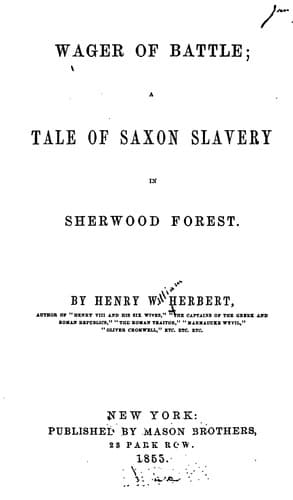
Wager of Battle: A Tale of Saxon Slavery in Sherwood ForestHerbert, Henry William
History
Wager of Battle: A Tale of Saxon Slavery in Sherwood Forest
Herbert, Henry William
Anglo-Saxons -- Fiction; Great Britain -- History -- Norman period, 1066-1154 -- Fiction; Sherwood Forest (England) -- Fiction
But as he spoke, the shrill and doleful wail of women came from the
porch of the house. "Ah, well-a-day! ah, well-a-day! that I should
live to see it. Soul of my soul, Kenric, my first-born and my best
one--thou first borne in, almost a corpse; and then, my darling and
delight--my fair-haired Edgar's son dead of this doleful fever. Ah,
well-a-day! ah, well-a-day! Would God that I were dead also, most
miserable that I am, of women!"
And then the manly voice of Kenric replied, but faint for his wounds
and wavering for the loss of blood; "Wail not for me, mother," he
said; "wail not for me, for I am strong yet, and like to live this
many a day--until thy toils are ended, and then God do to me as seems
him good. But, above all, I say to thee, wail not for Adhemar the
white-haired. His weakness and his innocence are over, here on earth.
He has never known the collar or the gyves--has never felt how bitter
and how hard a thing it is to be the slave of the best earthly master!
His dream--his fever-dream of life is over; he is free from yoke and
chain; he has awoken out of human servitude, to be the slave of the
everlasting God, whose strictest slavery is perfect liberty and
perfect love."
But still the woman wailed--"Ah, well-a-day! ah, well-a-day! would God
that I were dead, most miserable of mothers that I am!"
And the Norman barons stood unseen and silent, smitten into dumbness
before the regal majesty of the slave's maternal sorrow, perhaps
awakened to some dim vision of the truth, which never had dawned on
them until that day, in the serf's quarter.
CHAPTER VI.
THE SAXON'S CONSTANCY.
"And I'll be true to thee, Mary,
As thou'lt be true to me;
And I never will leave thee, never, Mary,
As slave man or as free;
For we're bound forever and ever, Mary,
Till death shall set us free--
Free from the chain of the flesh, Mary,
Free from the devil's chain--
Free from the collar and gyves, Mary,
And slavery's cursed pain;
And then, when we're free in heaven, Mary,
We'll pray to be bound again."
OLD ENGLISH SONG.
It was with grave and somewhat downcast brows, and nothing of
haughtiness or pride of port or demeanor, that the lord and his friend
entered under the lowly roof, invested for the moment with a majesty
which was not its own, by the strange sacredness of grief and death.
Public-domain text, read in full here on John Shaqi.
Reviews
Reviews
No reviews yet
Be the first to share your thoughts on this work.
Join the Discussion
Join the discussion
Sign in to leave a comment or review.
Sign InorCreate an account