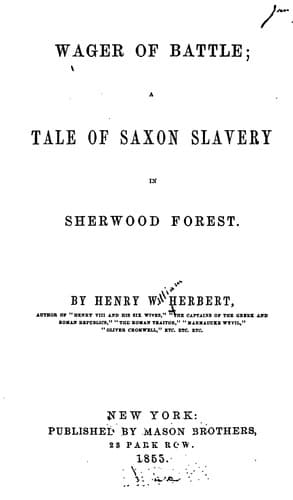
Wager of Battle: A Tale of Saxon Slavery in Sherwood Forest — John Shaqi
Wager of Battle: A Tale of Saxon Slavery in Sherwood ForestHerbert, Henry William
History
Wager of Battle: A Tale of Saxon Slavery in Sherwood Forest
Herbert, Henry William
Anglo-Saxons -- Fiction; Great Britain -- History -- Norman period, 1066-1154 -- Fiction; Sherwood Forest (England) -- Fiction
There never probably, in the whole history of the world, has been a
race of men, which entertained in their own persons a more boundless
contempt of death, or assigned less value to the mere quality of life,
than the warlike Normans. Not a man of them, while in the heyday of
life and manhood, would have hesitated for a moment in choosing a
death under shield, a death of violence and anguish, winning renown
and conferring deathless honor, to the gentlest decay, the most
peaceful dissolution. Not a man would have shed a tear, or shown a
sign of sorrow, had he seen his favorite son, his most familiar
friend, his noblest brother in arms, felled from his saddle in the
mêlée, and trampled out of the very form of humanity beneath the hoofs
of the charging cavalry. Not a man but would have ridden over a
battlefield, gorged with carcasses and drunk with gore, without
expressing a thought of terror, a sentiment beyond the victory, the
glory, and the gain. But such is the sovereignty of death, in the
silence and solitude of its natural gloom, stripped of the pomp and
paraphernalia of funereal honors, and unadorned by the empty braveries
of human praise and glory--such is the empire of humble, simple,
overruling sorrow, that, as they entered the low-roofed, undecorated
chamber, where lay the corpse of the neglected, despised serf--the
being, while in life, scarce equal to the animals of the chase--with
his nearest of kin, serfs likewise, abject, ignorant, down-trodden,
and debased--in so far as man can debase God's creations--mourning in
Christian sorrow over him, the nobles felt, for a moment, that their
nobility was nothing in the presence of the awful dead; and that they,
too, for all their pride of antique blood, for all their strength of
limb and heaven-daring valor, for all their lands and lordships, must
be brought down one day to the dust, like the poor slave, and go
forth, as they entered this world, bearing nothing out, before one
common Lord and Master, who must in the end sit in universal judgment.
Such meditations are not, perhaps, very common to the great, the
powerful, and the fortunate of men, in any time or place, so long as
the light of this world shine about, and their ways are ways of
pleasantness; but if rare always, and under all ordinary
circumstances, with the chivalrous, high-hearted, and hot-headed
knights of the twelfth century, they were assuredly of the rarest.
Yet now so powerfully did they come over the strong minds of the two
grave nobles, that they paused a moment on the threshold before
entering; and Yvo de Taillebois, who was the elder man, and of deeper
thoughts and higher imagination than his friend, raised his plumed
bonnet from his brow, and bowed his head in silence.
Public-domain text, read in full here on John Shaqi.
Reviews
Reviews
No reviews yet
Be the first to share your thoughts on this work.
Join the Discussion
Join the discussion
Sign in to leave a comment or review.
Sign InorCreate an account